





This is the first article in a six-part series exploring the aesthetic patient lifecycle in full. This piece introduces the framework and all seven stages at a high level. The five articles that follow will go deeper into the key stages and handoffs, with practical strategies for fixing the leaks specific to each part of the journey.
There are four numbers you need to know as an aesthetic practitioner:
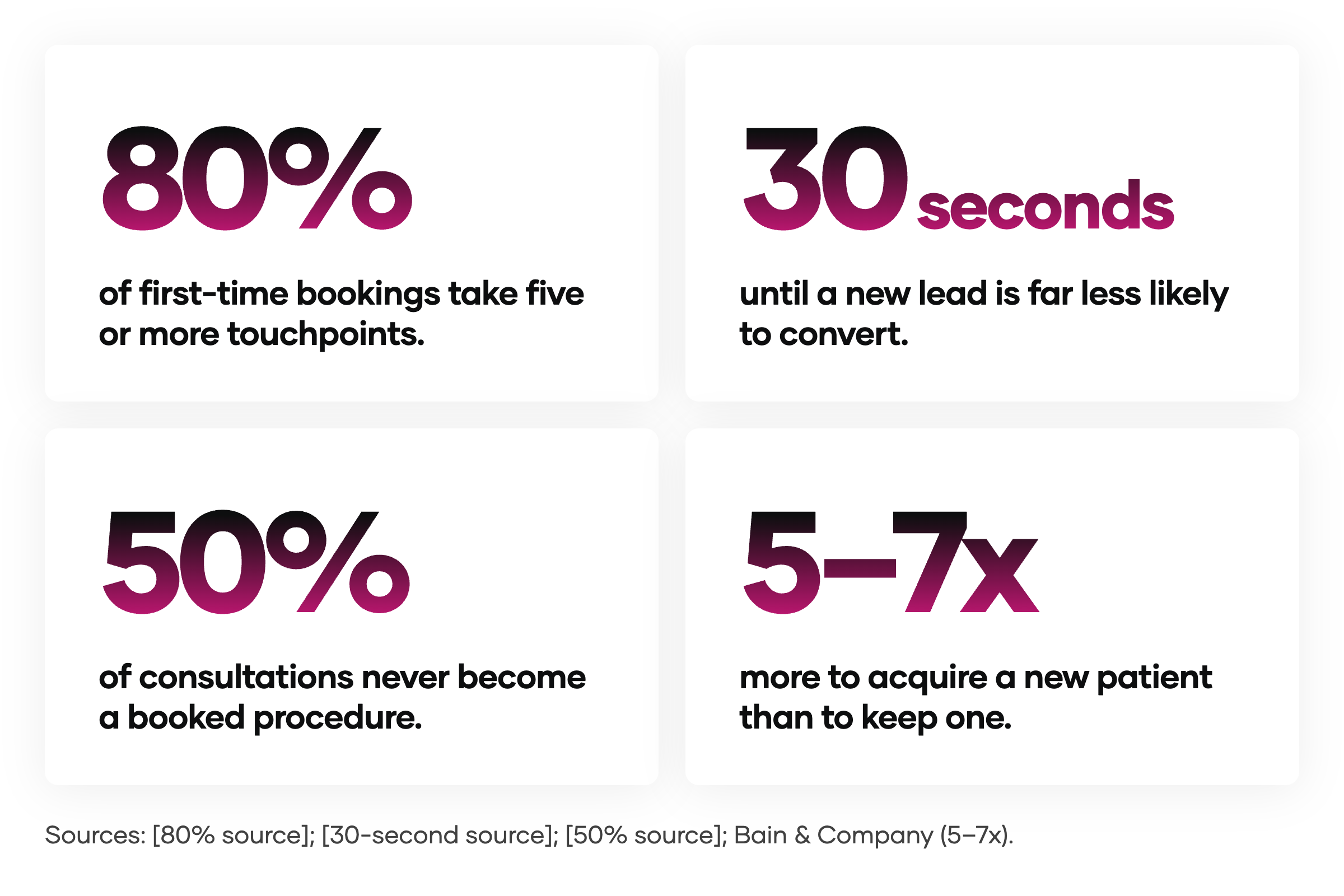
If you look at these stats individually, they’re simply frustrating.
However, when you put them all together, they point to something much bigger:

They're losing it gradually and consistently, in small leaks scattered across many stages of the patient journey.
The problem is, to fix this, you need to trace each stage and analyze what you're possibly doing wrong. And most practitioners don't understand what the actual patient journey even looks like.
They can point to their ad spend, their booking numbers, maybe their consultation-to-procedure ratio, but if you ask them to map out everything that happens between a stranger discovering their practice and that same stranger turning into a loyal patient, most of them miss crucial stages that cause them to lose money in the process.
This article helps fill in those blanks.
It breaks the aesthetic patient journey into seven distinct stages, a simple framework for understanding exactly what happens in each of them, and where, along the way, your practice is most likely losing revenue without ever knowing it.
The Real Aesthetic Patient Lifecycle
The aesthetic patient lifecycle breaks the patient journey into seven distinct stages:
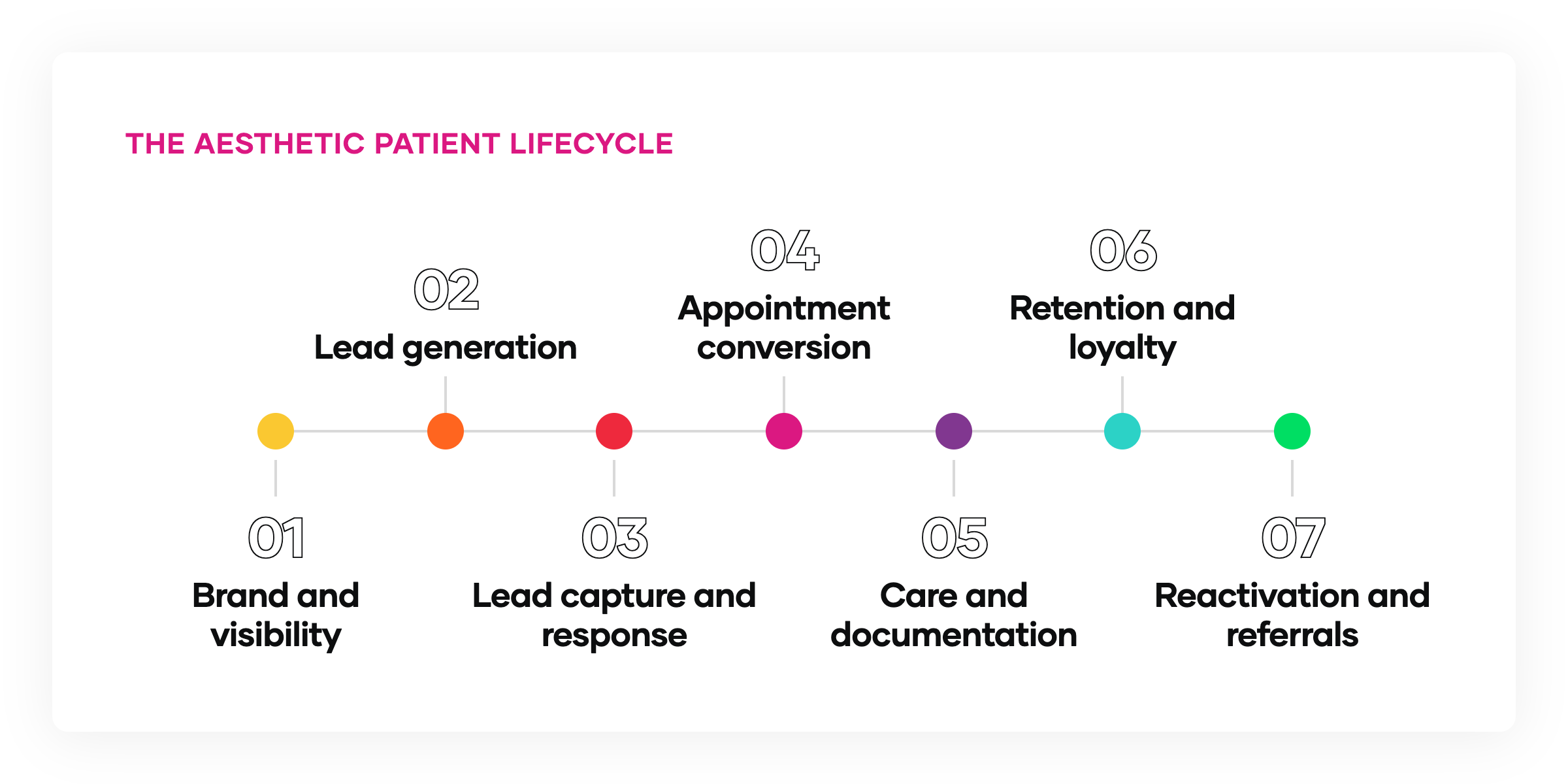
- Brand and visibility (getting found and trusted)
- Lead generation (converting interest into inquiries)
- Lead capture and response (catching the inquiry before it goes cold)
- Appointment conversion (turning an inquiry into a booked consultation and helping the patient decide what comes next)
- Care and documentation (what happens during and after the visit)
- Retention and loyalty (keeping patients active)
- Reactivation and referrals (winning back dormant patients and generating word of mouth)
Here's the pattern we see across the industry, almost without exception: practices invest heavily in stages 1 and 2. They spend on branding, on paid ads, on social content, on SEO (all with the intention of getting more people to know about them and getting more leads into the funnel).
That's a reasonable place to start.
But stages 3 through 7 are where the actual revenue either gets captured or quietly disappears, and they're consistently the most under-resourced part of the entire patient journey.

Because of that, a practice can spend enormous amounts of money filling the top of the funnel and still perform badly, simply because the middle and back half of that funnel is full of holes nobody's looking at.
Imagine it like this:
Let’s say there’s a restaurant that spent $500,000 on a gorgeous dining room and a killer marketing campaign to pack the place every night. Reservations are flying in. The phone won't stop ringing. Opening week, there's a line down the block.

The issue is, the team can only actually seat 30% of the people walking through it. Half the tables sit empty while people wait forever, orders come out wrong, and frustrated guests walk out before they even see a menu.
Just like with that restaurant, the problem we’re talking about here is not about getting people in the door of your aesthetic practice; it’s everything that’s supposed to happen after.
So, let's walk through all seven stages, one at a time, and see what the leak looks like at each one.
Stage 1: Brand and Visibility

This is where most marketing budgets start, and for good reason: if patients don't know you exist, nothing downstream matters. But "existing" and inspiring trust online aren't the same thing.
After all, every prospective patient does what every prospective patient does: Googles the practice, checks its Instagram, its website, its Google Business Profile and star rating, reads a few reviews, looks for before-and-afters.

Research consistently shows the large majority of aesthetic patients research a practice online before ever picking up the phone. A 2015 study of 500 patients at one clinic, published in Aesthetic Plastic Surgery, found that 95% used the internet to gather information before a consultation, with 68% using it as their first source of research. Social media is used by 46% of patients, and 40% of those patients report being strongly influenced by it when choosing a specific doctor.
So, the real problem is when what they find is... not quite enough.
The practice may be clinically excellent. It doesn't matter. If the digital presence doesn't back that up, the patient just moves on to the next name on their list.
Therefore, there are two possibilities of a leak at this stage:
- The leak that is invisible by definition (it's the patients who never even considered you, because they never encountered you in the first place).
- The leak of being unconvincing: a practice that hasn't invested in a professional website, photography, reviews, or a consistent social presence will still lose patients who would have been perfect fits, simply because nothing they saw gave them a reason to pick up the phone.
Want to fix this? Here’s a good place to start: Google your own practice name like a prospective patient would.
What comes up? Is there enough social proof? Are the photos current and professional? Is your Google Business Profile complete?
We'll go much deeper on fixing this in the next article in the series; for now, the goal is just recognizing where the gap might be.
Stage 2: Lead Generation

Once visibility exists, the next question is whether it's translating into actual leads, and this is where one of the stats we’ve recalled at the beginning becomes essential context.
80% of first-time bookings require five or more touchpoints before a patient actually schedules. That means a single ad campaign, a single email, or a single social post is almost never going to be the thing that converts a new patient on its own.
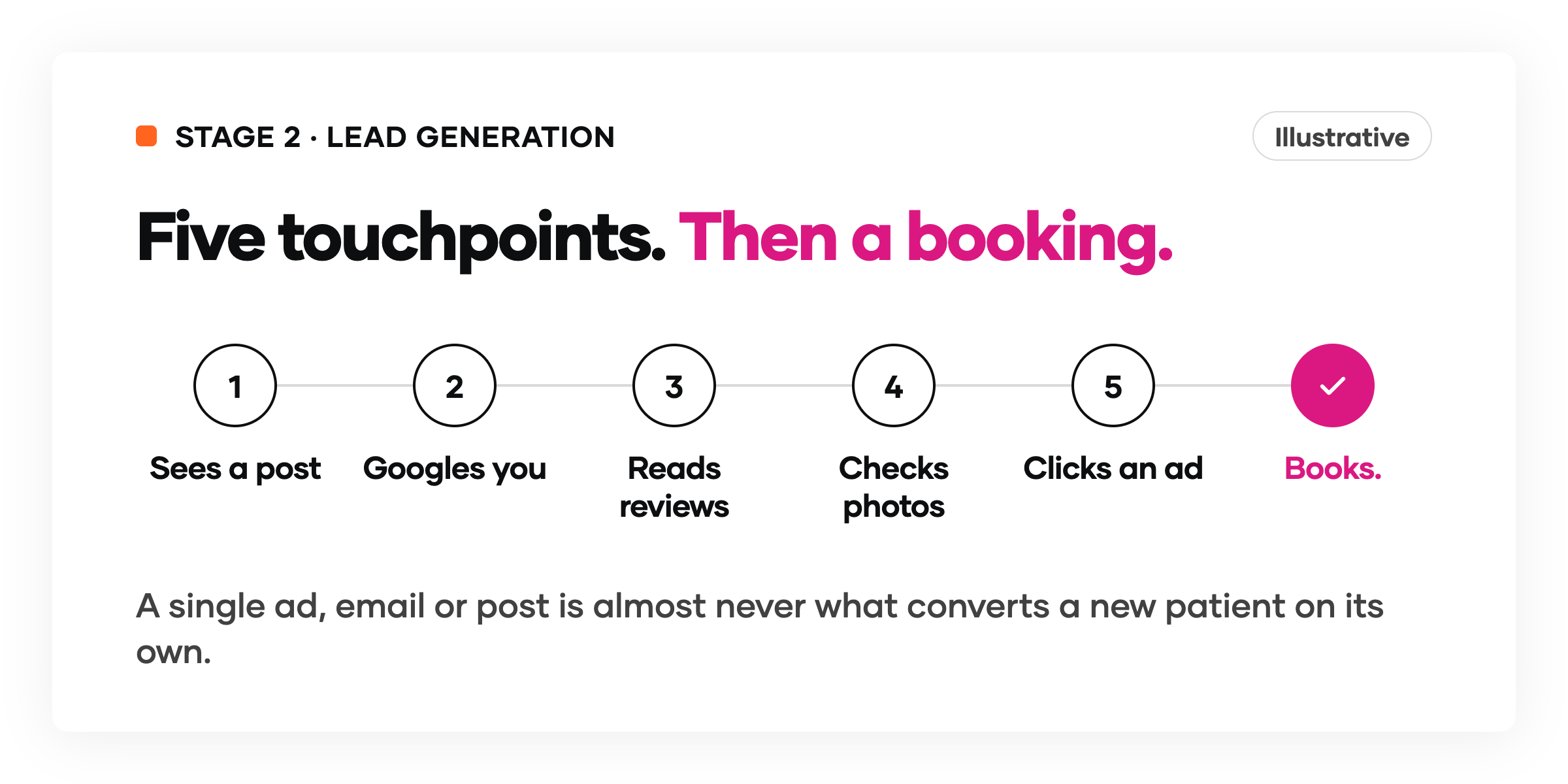
This is also where single-channel paid media tends to underperform relative to expectations. A practice running only Instagram ads, or only Google ads, is relying on one channel to deliver all of those touchpoints, and it's also fully exposed to a single algorithm change, cost-per-click spike, or ad account issue wiping out its lead volume overnight.
To truly generate consistent, high-quality leads you need to be building visibility across multiple channels, where brand recognition from stage 1 makes each subsequent touchpoint more effective than the last.
And that's where we run into the compounding effect of brand on lead quality, because lead quality was never really a lead generation problem to begin with. It's downstream of how strong the brand foundation already is.
Here's the simplest way to think about it:

The ad doesn't create trust, it just points to it. If the brand behind that ad already has the reviews, the photos, the credibility, the ad is pointing to something worth trusting, and the lead that clicks through arrives already halfway convinced.
That’s why brand builds over time in a way paid media doesn't. Every new review, every before-and-after, every piece of content makes the next lead cheaper and easier to convert. Paid media is essentially renting attention (it stops working the moment you stop paying for it), while a good quality brand always keeps working in the background.
And what happens when a good lead reaches the next stage?
You did the hard part. You spent the money, ran the ads, got someone curious enough to reach out. And then... nobody caught them. The lead just sat there, cooling off by the hour, until it was too cold to save.
Let's fix that next.
Stage 3: Lead Capture and Response

It's a Friday evening. A patient fills out a consultation form for lip filler after scrolling your Instagram for twenty minutes. Nobody sees it until Monday morning. By then, she's already called two other practices over the weekend and booked with one of them.

Your practice never even knew it was competing. That's the story behind this stage, and it plays out more often than most owners realize.
The moment a lead comes in, a countdown starts.
Research on lead response time consistently shows conversion probability dropping fast within the first few minutes:
- After 30 minutes, a lead is significantly less likely to convert.
- After 24 hours, most are effectively gone.
The practice that responds first, consistently, wins a disproportionate share of bookings, not necessarily because they're better, but because they showed up when the patient was actually ready to talk.
What’s worth noting here is that a "response" doesn't just mean acknowledging the inquiry. And while yes, a message that says "thanks, we'll be in touch" is better than silence, it’s still not much.
Real response means qualifying the patient, answering their likely questions, and moving them toward an actual booking. The goal is a conversation.
And here's the part that catches most practices off guard: more leads arrive outside business hours than you'd expect. Aesthetic patients are often researching and deciding in the evenings and on weekends (after work, on their phones, when they finally have a minute to think about themselves).
A practice that only responds 9-to-5 is structurally missing a meaningful chunk of its own lead volume.
This is exactly the gap AI-powered response tools like Recura are built to close: answering every lead within 30 seconds, any hour, any day, qualifying the patient and moving them toward a booking without a staff member ever picking up a phone.
The leak at this stage is probably the most preventable, yet most expensive, in the entire lifecycle: real money spent generating a lead that simply disappears because nobody responded fast enough.
Stage 4: Appointment Conversion

Roughly half of all aesthetic consultations never result in a booked procedure. Think about what that actually means: all that chair time, all that staff time, all that overhead spent running the consultation, and half the time… none of it turns into revenue.
Often this gets blamed on the consultation itself (maybe the provider needs better sales training, maybe the pricing conversation needs work). Sometimes that's true.
But just as often, the patient just needed more information, more reassurance, more time. They said "I'll think about it." They asked about financing. They wanted to check with their partner.
…And then nobody followed up, or followed up once, got silence, and quietly wrote them off.
A nurture sequence is the fix, and it's not spam. It's a structured set of follow-up touchpoints (usually a mix of email, SMS, and sometimes voice) built to answer the specific objections that cause patients to hesitate.
Each one moves the patient a step closer to yes.
Most practices stop after one follow-up. But the data says most hesitant patients need two or three more touchpoints before they actually commit.

This connects directly back to stage 3. The same system that responds to a new inquiry in 30 seconds (like Recura's AI sales director) can run this post-consultation nurture sequence automatically too, following up, answering questions, and moving the patient toward booking without a staff member having to manage it by hand.
The leak at this stage: the practice ran the consultation well, then dropped the ball the second the patient walked out the door. A hesitant patient isn't a no, but too many practices treat it like one, instead of treating it as the start of the nurturing process.
Stage 5: Care and Documentation

Most practices think of this stage as purely clinical, separate from marketing or retention. They couldn’t be more wrong.
In fact, practices that document consultations thoroughly (treatment history, patient goals, notes from previous visits, before-and-after photography) retain patients at meaningfully higher rates, simply because the relationship feels continuous and personalized rather than transactional.
After all, aesthetic patients are having a deeply personal experience at a consultation. They're sharing insecurities, making appearance-related decisions, spending real money.

That’s why a practice that can reference their previous treatments, remember their preferences, and track their results over time creates a fundamentally different experience than one where every visit feels like starting from scratch with a stranger.
Tools like PatientNow's AI Scribe make this easier by automatically generating structured consultation notes from the room conversation for the provider to review, so the clinical record stays thorough without eating into the provider's time with the patient.
Before-and-after photography deserves its own mention here, since it's usually categorized as a marketing asset, and it's just as much a retention asset.
Showing a patient their own progress at a follow-up visit is one of the most effective ways to reinforce the value of what was already done, and naturally sets up the conversation about what comes next. RxPhoto builds this directly into the patient record, rather than leaving it scattered across phones and folders.
Therefore, a leak at this stage happens when a practice does genuinely good clinical work, but leaves no real trail of the relationship behind it. Patients feel like they're starting over every visit, and an experience that should compound over time never does.
Stage 6: Retention and Loyalty

At this stage, the math becomes impossible to ignore:

It costs five to seven times more to acquire a new patient than it does to retain or reactivate an existing one.
That's well-established research from Bain & Company, and it holds across industries, but it's especially visible in aesthetic medicine, where patient lifetime value tends to be high, and the cost of acquiring someone new (marketing, consultation time, staff hours) is high too.
And yet, retention is consistently one of the most under-invested stages in the entire lifecycle.
Most practices spend heavily to bring new patients in the door and almost nothing to keep the ones they already have, even though the real opportunity is already sitting in their own database (hundreds, sometimes thousands, of past patients who trusted them enough to book once).
Left untouched, it's worth nothing. But with systematic retention, you can tap into that value.
Systematic retention can look like:
- AI-powered email and SMS campaigns,
- automated appointment reminders,
- re-engagement touchpoints,
- loyalty or membership tiers that give patients a reason to come back on a schedule.
None of these ideas are complicated to carry out; what most practices are missing is just the system to actually run them.
PatientNow's engagement tools (AI-powered campaigns, loyalty programs, automated reminders) are built to handle this systematically, without requiring staff to manually manage outreach for every single patient.
So, what’s the leak at this stage?
A patient who had a great experience simply doesn't come back, not because they're unhappy, but because nobody asked them to. So the practice spends more money acquiring their next patient, instead of the fraction of that it would have cost to re-engage the one who already knew and trusted them.
Stage 7: Reactivation and Referrals

The final stage closes the loop, and it's where a dormant patient database turns back into active revenue.
After all, you need to remember that dormancy isn't the same as churn.
Most dormant patients in aesthetic medicine went quiet simply because nobody reached out, not because they had a bad experience or decided to go elsewhere.
Reactivation campaigns (targeted, well-timed outreach to patients who haven't booked in a while) can turn a "lost" patient back into a returning one for a fraction of what it costs to acquire someone brand new.
Connect by PatientNow syncs the full EMR data (demographics, lifetime spend, last visit date, membership status, appointment history) into Recura's AI targeting system. A practice can build a segment in plain language: patients who haven't visited in 120 days and spent over $500 last year, for example.
That's a list of real people with real money already spent on this kind of care, and the outreach can happen automatically from there.

The system runs six campaign types, each built for a specific scenario:
- dormant recovery,
- membership upsell,
- treatment cross-sell (for example, a Botox patient who might be a great fit for filler),
- VIP win-back,
- no-show recovery,
- new lead engagement.
Different situation, different message, but same underlying idea: reach the patient before they drift somewhere else.
Loyal patients, including those you've reactivated, can also become valuable referral sources. A patient who felt heard, who saw their own before-and-after progress, who was personally re-engaged by the practice that treated them, that patient tells their friends. That's stage 7 feeding directly back into stage 1, creating a full circle.
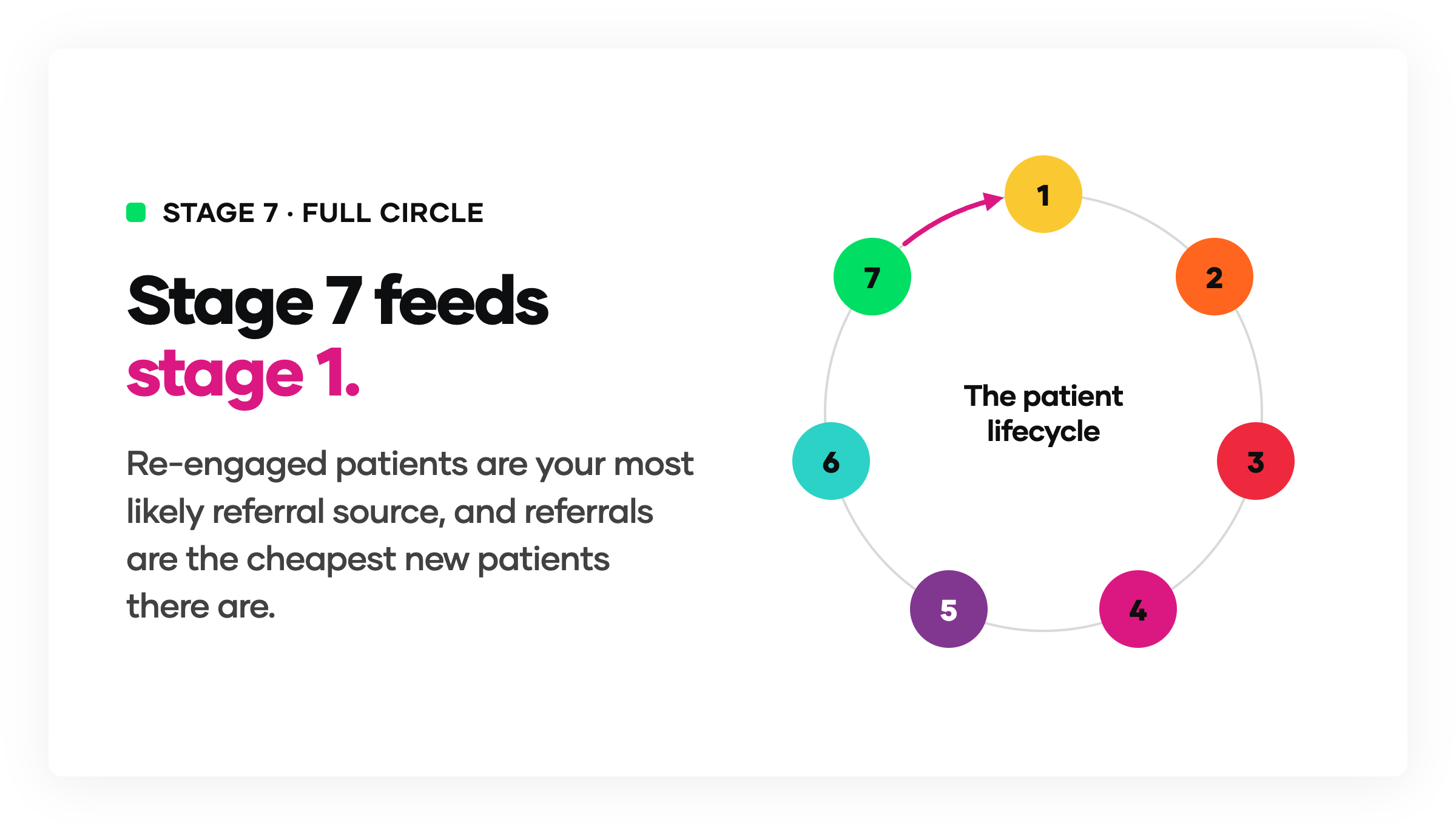
The leak at this stage: the database sits unused, the practice keeps spending five to seven times as much acquiring new patients instead of re-engaging the ones it already has, and the referral engine (the cheapest, most powerful form of new patient acquisition available) never gets switched on.
Where Is Your Practice Actually Leaking?
Here's the exercise worth running for your own practice: go stage by stage, honestly, and ask where the biggest gap sits:
- Stage 1: When did you last Google yourself as a prospective patient? What did you find?
- Stage 2: What's your current cost per lead, and what's your conversion rate from lead to consultation?
- Stage 3: What's your average response time to a new inquiry? Would you know if a lead came in at 9pm on a Friday?
- Stage 4: What's your consultation-to-booking rate? What happens after a consultation when the patient says "I'll think about it"?
- Stage 5: Can you pull up the treatment history for a patient in under 30 seconds? Do you have before/after photos for most of your patients?
- Stage 6: How do you help current patients stay on track with follow-up and rebooking?
- Stage 7: How many patients in your database haven't been in for over a year? Do you know that number?
Most practices have a clear answer for two or three of these questions. The others are where the money is going.

Want to see exactly where your practice's biggest leak is?
Download the full aesthetic patient lifecycle infographic, and register for our upcoming webinar series, where we'll break down each stage in more depth.

Frequently Asked Questions
What are the seven stages of the aesthetic patient lifecycle?
The seven stages are brand and visibility, lead generation, lead capture and response, appointment conversion, care and documentation, retention and loyalty, and reactivation and referrals. Together, they map the full patient journey, from discovering a practice to becoming a loyal patient who may refer others.
Why do aesthetic practices lose revenue after generating leads?
Many practices invest heavily in branding, advertising, and lead generation but overlook what happens after a potential patient makes an inquiry. Slow response times, inconsistent follow-up, missed consultation opportunities, and weak retention strategies can cause valuable leads and existing patients to slip away.
How can aesthetic practices convert more consultations into booked procedures?
Consistent post-consultation follow-up is essential. Patients may need more information, reassurance, or time before making a decision. A structured nurture sequence using email, SMS, and other touchpoints can address their concerns and keep the conversation going rather than treating hesitation as a rejection.
How does patient documentation improve retention in aesthetic medicine?
Thorough documentation helps practices create a more personalized and continuous patient experience. Keeping track of treatment history, patient goals, consultation notes, and before-and-after photos allows providers and staff to understand each patient's journey and demonstrate progress over time.
Why is patient retention important for aesthetic practices?
Retaining existing patients generally costs significantly less than acquiring new ones. Automated reminders, personalized email and SMS campaigns, re-engagement touchpoints, and loyalty or membership programs can encourage patients to return and increase their lifetime value.
How can aesthetic practices reactivate dormant patients and generate more referrals?
Practices can use targeted reactivation campaigns to reach patients who haven't booked in a while. By segmenting their patient database based on factors such as last visit, treatment history, and lifetime spend, they can send more relevant outreach. Patients who have a positive, personalized experience can also become valuable sources of word-of-mouth referrals.
Too Long? Here's the Short Version
The aesthetic patient lifecycle consists of seven stages: brand and visibility, lead generation, lead capture and response, appointment conversion, care and documentation, retention and loyalty, and reactivation and referrals. While most practices focus heavily on attracting new patients, revenue is often lost in the stages that follow. Slow lead response, missed follow-ups, inconsistent patient documentation, and a lack of retention strategies can all prevent practices from maximizing patient lifetime value. Understanding and optimizing each stage helps turn more inquiries into bookings, one-time patients into loyal patients, and dormant databases into new revenue opportunities.
The aesthetic patient lifecycle consists of seven stages: brand and visibility, lead generation, lead capture and response, appointment conversion, care and documentation, retention and loyalty, and reactivation and referrals. While most practices focus heavily on attracting new patients, revenue is often lost in the stages that follow. Slow lead response, missed follow-ups, inconsistent patient documentation, and a lack of retention strategies can all prevent practices from maximizing patient lifetime value. Understanding and optimizing each stage helps turn more inquiries into bookings, one-time patients into loyal patients, and dormant databases into new revenue opportunities.