






.svg)


So, we are already a month in – how are your New Year's resolutions going?
…
Yep, that's what I thought 😉
I know so many people dread when this time rolls around – when you have to face everything you still need to change about your life in the coming year. And I get it. I’ve been there. In fact, if some of you saw the absolutely unhinged "master to-do lists" I make every month, you'd already be reaching for a stress ball.
You see, the issue is that for many of us, goal-setting feels less like strategic planning and more like just signing up to feel bad about ourselves three months later. And there’s a reason for that.
"I want a six-pack" – wrote almost every guy in his 30s on his 2026 bucket list. But what does this goal actually tell you, except that you have a wish?
Because that's exactly what it is. A wish. And wishes don't build muscle.
You want a six-pack? Alright – then you need to work out four times a week focusing on core training and cardio, track your calorie intake to maintain a 500-calorie deficit, and commit to this routine for the next six months with progress check-ins every four weeks. That's a SMART goal. It's specific, measurable, achievable, relevant, and time-bound.
"Okay Sam, I get it, but what does hitting the gym have to do with running my practice?"
I’m glad you asked. The same principle applies in aesthetic marketing:
"Let's 10x our Instagram followers!" Sure, until you remember you're also managing patients, staff issues, inventory, and that 10x is about as realistic as that six-pack appearing after one week of salads.
"Let's grow our patient base!" Great, except this doesn't even include a concrete number or timeline for how much growth you're targeting.
See the pattern? The problem isn't the concept of goals. It's that most goals are just two wishes in a trenchcoat pretending they’re the adults in the room. There’s no structure. No milestones. No honest reckoning with what you can pull off with the team, time, and budget you have. Just vibes, optimism, and crossed fingers – which, spoiler alert, is not a strategy.
Here’s the change you need to make: stop fixating on wanting a "six-pack" and start becoming the kind of person who's fit and healthy. Stop saying you want to "grow your practice" and start building the systems that make growth inevitable.
After all, the best goals aren’t the ones that sound impressive at a conference happy hour. They’re the ones you can actually check off by December 31st without crying into a protein shake.
Let's make 2026 the year your goals finally happen.
What is a SMART Goal?
You've probably heard the term "SMART goals" thrown around before, maybe in a webinar you half-watched while checking your email or a business book collecting dust in your office. (We all have that shelf. No judgment.)
I know it sounds like corporate jargon. But here's the thing: SMART goals aren't just buzzword soup. They're the difference between "we want to grow this year" and "we're going to increase new patient consultations by 25% by Q3."
One of those feels good to say. The other actually gets done.
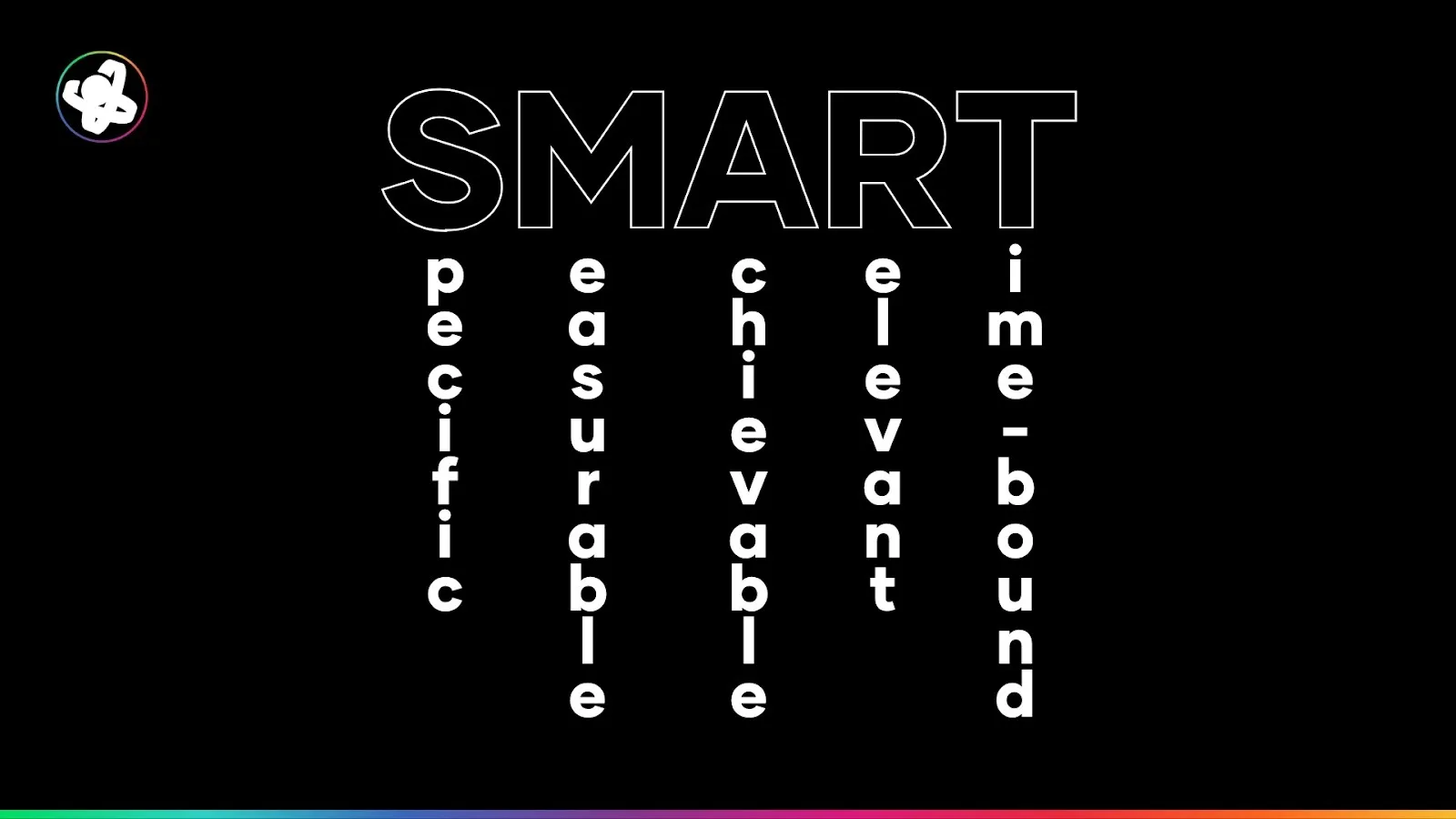
SMART is a framework – a way to take those big, exciting, slightly intimidating ambitions and turn them into something you can execute. Let's break it down:
S - Specific
- Clear and unambiguous – what exactly do you want to achieve?
Vague goals lead to vague results. When everyone on your team knows exactly what success looks like, they can take action without waiting for permission or clarification. Specificity drives execution.
M - Measurable
- Trackable with metrics or milestones
If you can't measure it, you can't manage it. Period. Your goal needs numbers attached, whether that's revenue, patient volume, engagement rates, or consultation bookings. Measurable goals tell you if you're winning, losing, or stuck spinning your wheels somewhere in between.
A - Achievable
- Realistic given resources, team, and time – taking into consideration your practice tier
Nothing kills momentum faster than setting goals that are impossible to hit. Achievable doesn't mean easy – it means possible with the resources you have. Know your tier (more on that in a moment), know your capacity, and set goals that stretch you without snapping you in half.
R - Relevant
- Tied to what you want to achieve
Every goal should ladder up to your bigger vision. If your main priority is growing your patient base, then a goal about redesigning your logo probably isn't relevant right now. Stay focused on what moves the needle for your practice.
T - Time-bound
- Has a clear deadline or milestone
Deadlines create urgency, accountability, and a forcing function that keeps you from letting goals drift into the land of "we'll get to it eventually."
The bottom line: properly defined SMART goals set you up for success.
They turn ambition into action, strategy into execution, and hope into measurable progress. So before you set another goal that sounds good but goes nowhere, take the time to make it SMART. Your future self (and your team) will thank you.
What kind of practice am I?
Before you can set SMART goals, you need to know where you're starting from. Not in some vague "we're doing okay" way, but with an honest assessment of your practice's size, resources, and operational abilities.
A solo practitioner doesn't have the same marketing needs as a multi-location practice with a dedicated marketing team. That’s not a bad thing, it's just reality. The only mistake is setting goals for a practice you don't actually have.
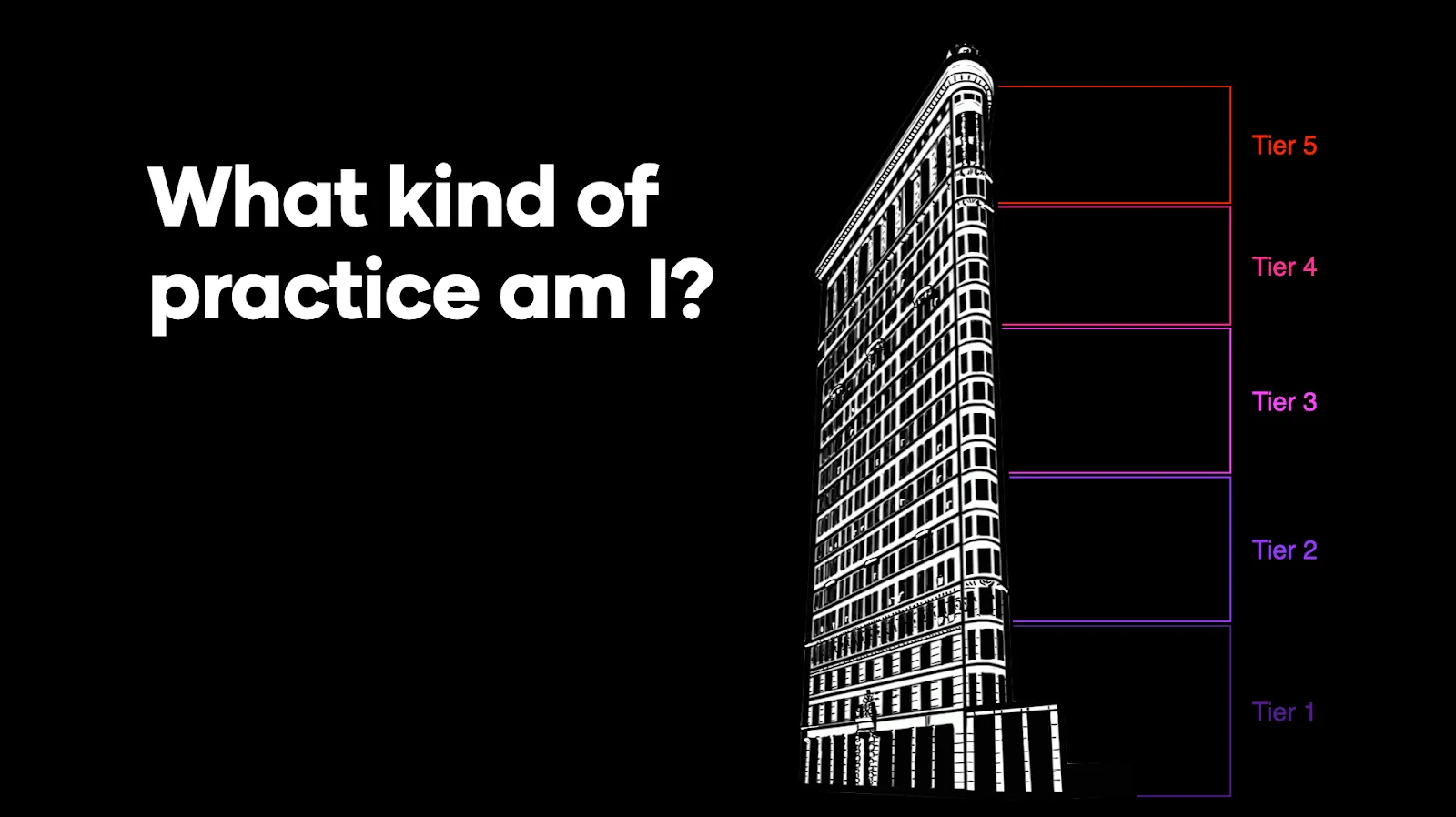
Here's how I think about it. After working with hundreds of practices across dozens of countries, I’ve seen that virtually all fit into one of five tiers. Understanding your practice tier is key to setting goals that challenge you without setting you up to fail.
Tier 1 - Start up / Foundational

- 1 location, a small team (1-5 people)
- Marketing may be occurring, but not necessarily. Everything must be built from scratch – from the website and social media presence to the first ads and emails. There’s no real system yet, just a lot of hands-on effort and learning as you go.
- Revenue: less than 1 million USD per year
If this is you: You're probably wearing seven different hats on any given day. Marketing happens when you have time, which is almost never. Your goals should focus on building foundational systems that help you make consistent progress toward your goals without burning out.
Tier 2 - Small

- 1 location, small team (5-10 people)
- Starting to invest in marketing – all foundational marketing components are present
- Revenue: less than 2 million USD per year
If this is you: You've grown past the solo hustle and you're starting to think strategically about marketing. You might have someone helping part-time or you're carving out a real budget for ads and content. Your goals should focus on creating repeatable processes and ramping up visibility.
Tier 3 - Mid-sized

- 1-2 locations, mid-sized team (10-20 people)
- Marketing in place, scaling growth
- Revenue: 2-5 million USD per year
If this is you: You've got momentum. Marketing isn't an afterthought; it’s part of your operation. You're coordinating across multiple locations and starting to see what works at scale. Your goals should focus on optimization, coordination, and capturing more market share.
Tier 4 - Large

- Multi-location, large team (20-50 people)
- Advanced marketing/operations, ready for aggressive growth
- Revenue: 5-15 million USD per year
If this is you: You're a serious player in your market. Marketing is sophisticated and data-driven, and you've got the infrastructure to support bold moves. Your goals should focus on differentiation, dominance, and scaling what's working into new markets or service lines.
Tier 5 - Established / Enterprise

- Multi-region, large team (50+ people)
- Marketing fully structured and optimized across regions, aiming for market domination
- Revenue: 10+ million USD per year
If this is you: You're not competing – you're setting the standard. Marketing is a well-oiled machine with dedicated teams, robust analytics, and multi-channel strategies. Your goals should focus on innovation, brand authority, and capturing market leadership regionally or nationally.
So, which tier are you?
Be honest. Don't aspirational-tier your way into goals you can't execute. Don't underestimate what you're capable of, either. Give yourself the right roadmap for where you are right now.
And remember, these tiers are guides, not rigid labels. You might earn more yet operate like an earlier-tier practice, or earn less while having strong foundations in place. The point is to assess your current reality honestly so you can make smarter decisions about what comes next.
In other words: know your starting line before you set your finish line. Everything that follows depends on it.
Why is setting SMART goals important?
Growth doesn't happen by accident. Sure, you might get lucky here and there, because a patient refers a friend or a TikTok video randomly goes viral.
But that's not a strategy. That's hope with a side of good timing.
Real, sustainable growth requires intention. And intention starts with goals – not the vague kind, but the SMART kind that gives your team something to work toward and a scoreboard to measure against.
Here's why this matters:
- Every action should connect to something bigger. When you set clear goals, every marketing decision suddenly has context. Should you invest in that new ad campaign? Does this collaboration make sense? Is this social media trend worth your time? Goals give you a filter, a way to say yes to what moves you forward and no to what's just noise.
- Goals define growth. Without clear targets, growth is abstract. Did you have a good quarter? Hard to say. Are your marketing efforts working? Who knows. But when you set specific goals – like "increase new patient consultations by 20%" or "boost Instagram engagement by 30%" – you suddenly have a scoreboard. Growth is now something you can measure, manage, and improve on.
- The compounding effect is real. Think of your goals like compound interest. One good month doesn't change everything. But when you execute on your plan consistently and let those efforts stack on top of each other? That's when things accelerate. Small wins build momentum. Momentum builds confidence. Confidence leads to bigger moves. But none of that happens if you're winging it month to month.
Competition in aesthetics is only getting fiercer. The difference between busy and productive, between spinning your wheels and moving forward, has never mattered more.
That’s why setting SMART goals for 2026 is critical – not to add more to your plate, but to make sure everything on your plate is worth eating.
Now let’s talk about the goals that should make up your 2026 marketing meal.
Goal #1 Build a Marketing Plan
I know what you're thinking: "You mean I need a plan... for my plans?"
Yes. That is what I'm saying. And before you roll your eyes so hard they get stuck (looking at you, every practice that's been "about to write a marketing plan" for the last three years), let me tell you what happens without one.
You post on Instagram because you feel like you should. You run ads because a rep convinced you to. You send emails when someone on your team remembers. You react to whatever your competitor is doing. Nothing connects, and nothing compounds. At the end of the year, you can't tell what worked because you never defined what "working" means.
If you want to hit real marketing goals in 2026, make it the year you let go of reactive marketing and move into deliberate, strategic execution.
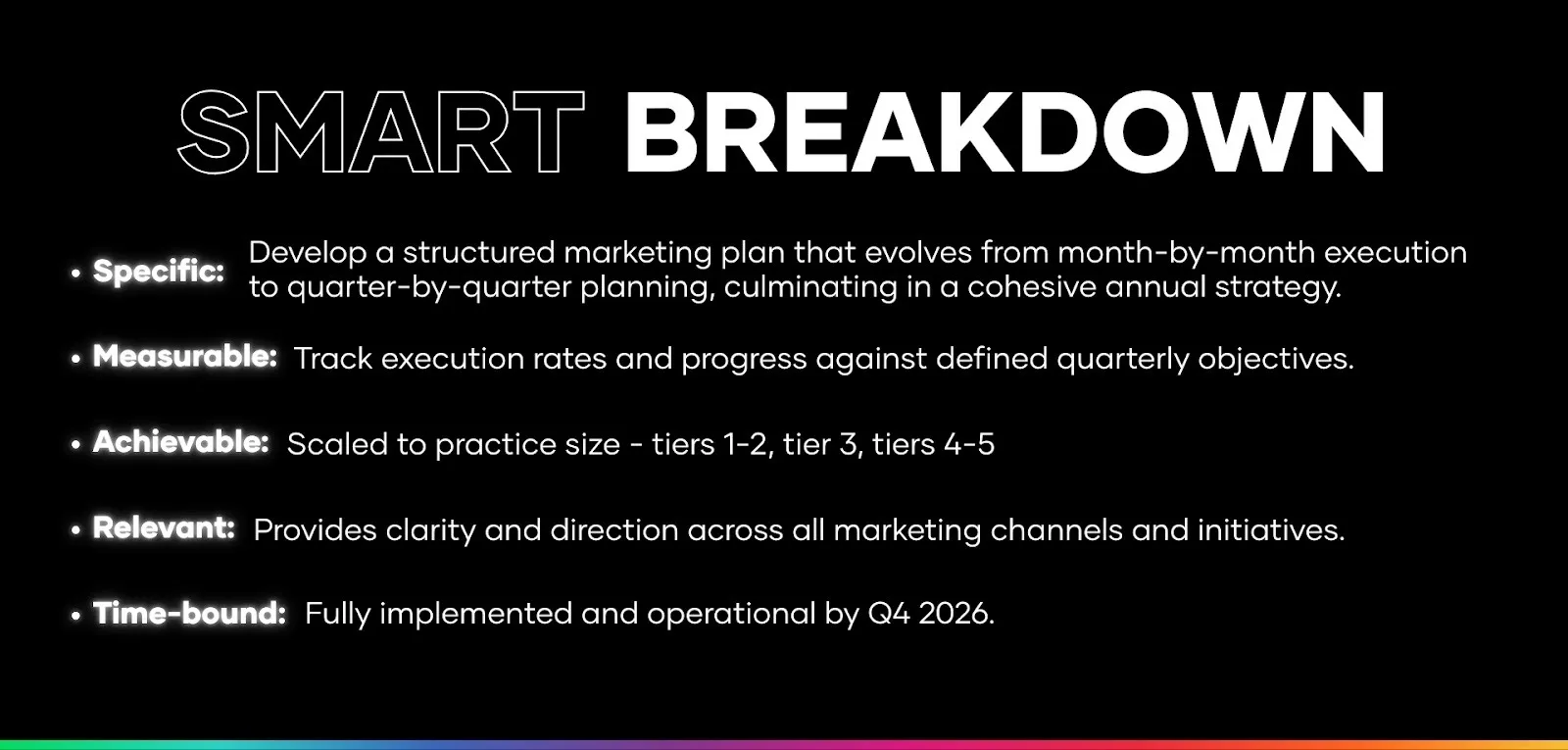
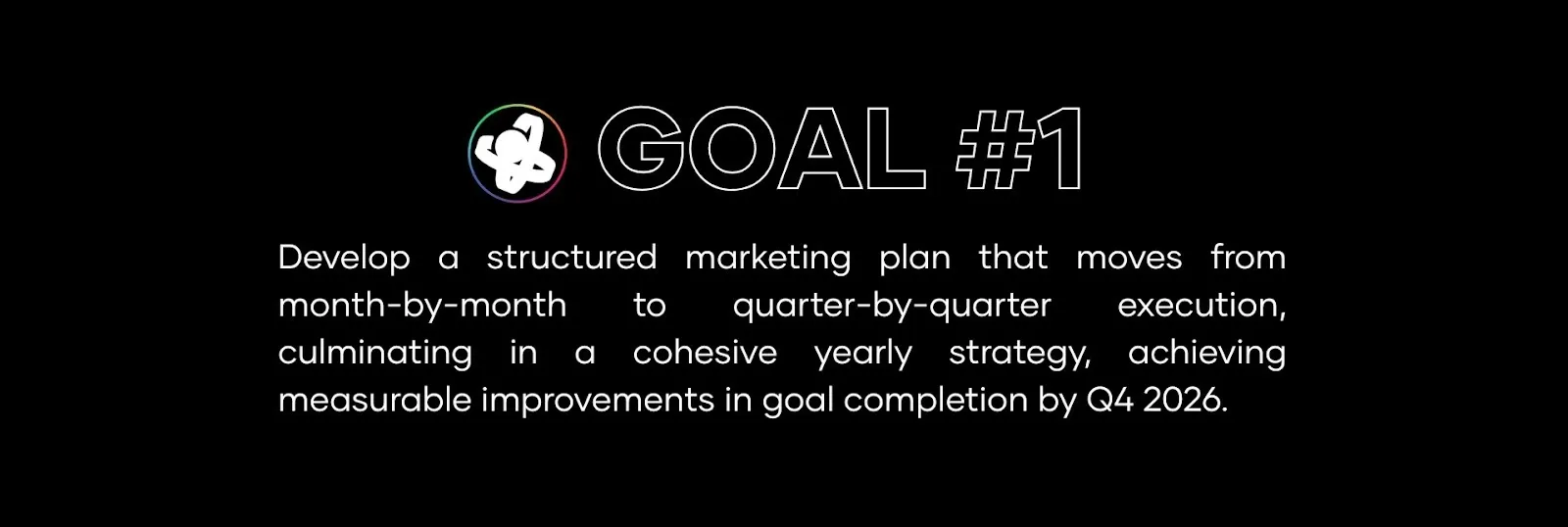
How? By building a clear structure where monthly actions ladder up to quarterly priorities, and those priorities drive your yearly strategy. This plan becomes the filter for every decision you make.
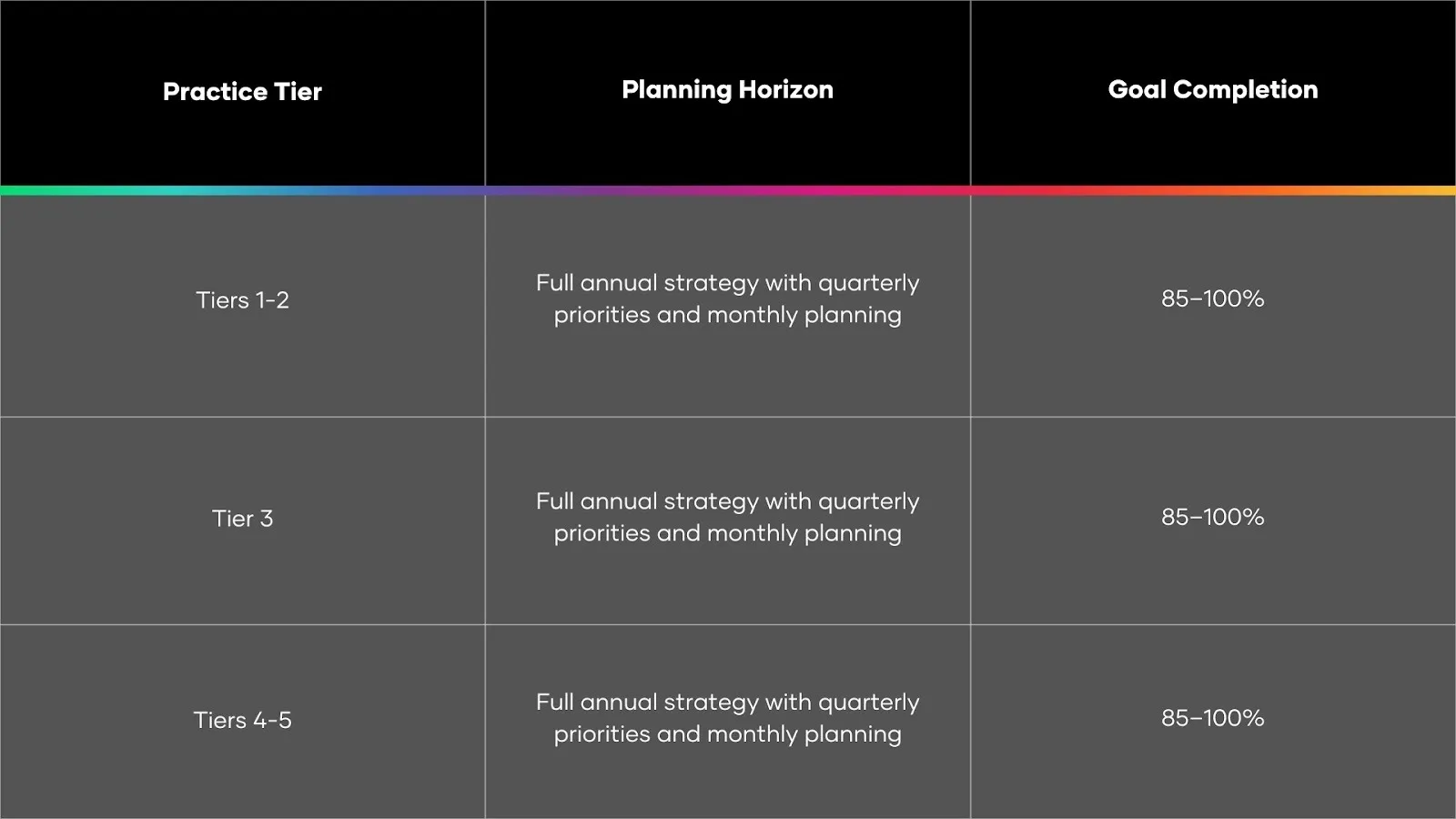
Yes – I know this is all the same. It’s meant to be.
Whether you're a solo practitioner or running multiple locations, you need a yearly strategy that tells you where you're going, quarterly priorities that keep you on track, and monthly planning to make sure stuff actually gets done. The difference between practice tiers isn’t whether you need a plan but how intricate and resource-intensive executing that plan is.
…Which brings us to the next goal:
Goal #2 Make Paid Ads Pay You Back
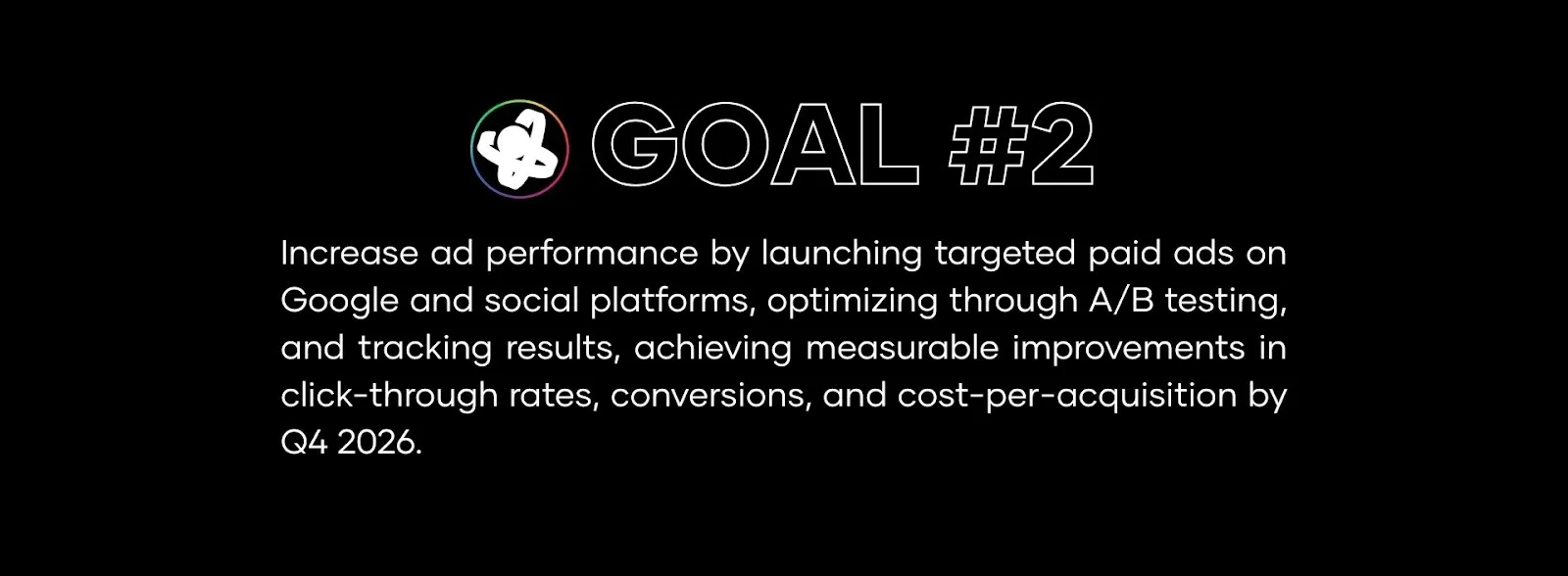
Look, paid ads are hard – there's no sugarcoating it.
Between platform algorithms that change constantly and audience targeting that can feel like throwing darts blindfolded, it's easy to see why so many practices get burned. Making paid ads work for you requires more than hitting "boost post" and leaving campaigns on autopilot for months, hoping for the best.
In 2026, you know better than to call that strategy. That’s just an expensive way to make Mark Zuckerberg’s day.
Done right, paid media starts working like a growth engine that keeps revving up. Your goal for 2026 is to make your paid ads more efficient, more predictable, and more profitable.
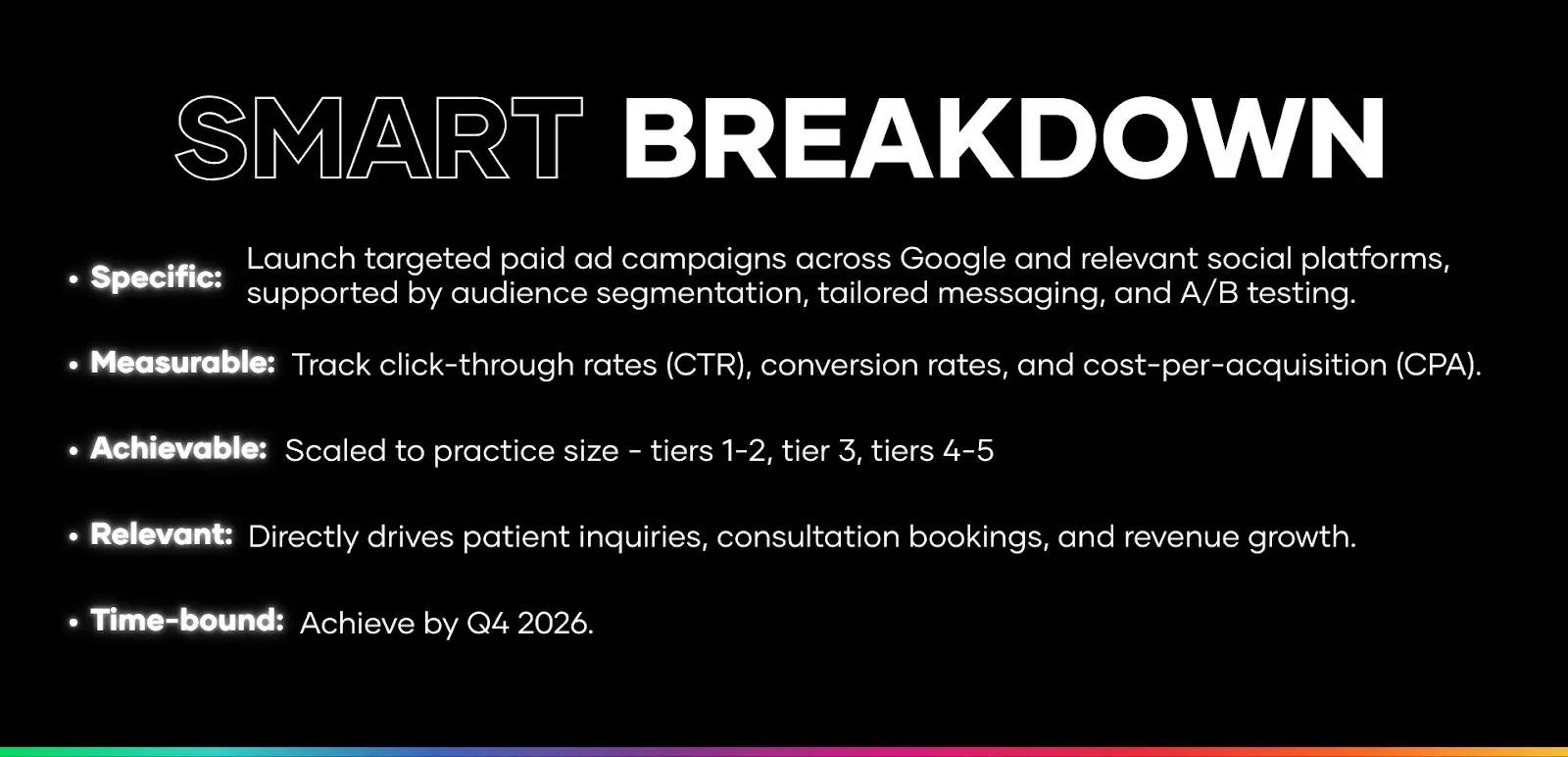
Build campaigns around high-intent actions (which get you bookings), not just awareness (which gets you likes). Create separate campaigns for separate goals:
- One for new patient acquisition targeting people actively researching procedures in your area
- One for retargeting website visitors who browsed your mommy makeover page but didn't book
- One for nurturing your existing patient list with loyalty offers
- Etc…
Continuously test creatives, headlines, audiences and offers, and double down on what converts. Don’t judge ad performance by impressions or reach alone, but by hard metrics like CTR, conversions, and cost-per-acquisition. If a campaign doesn’t justify its spend, kill it and reallocate.
What does that look like for each practice tier?
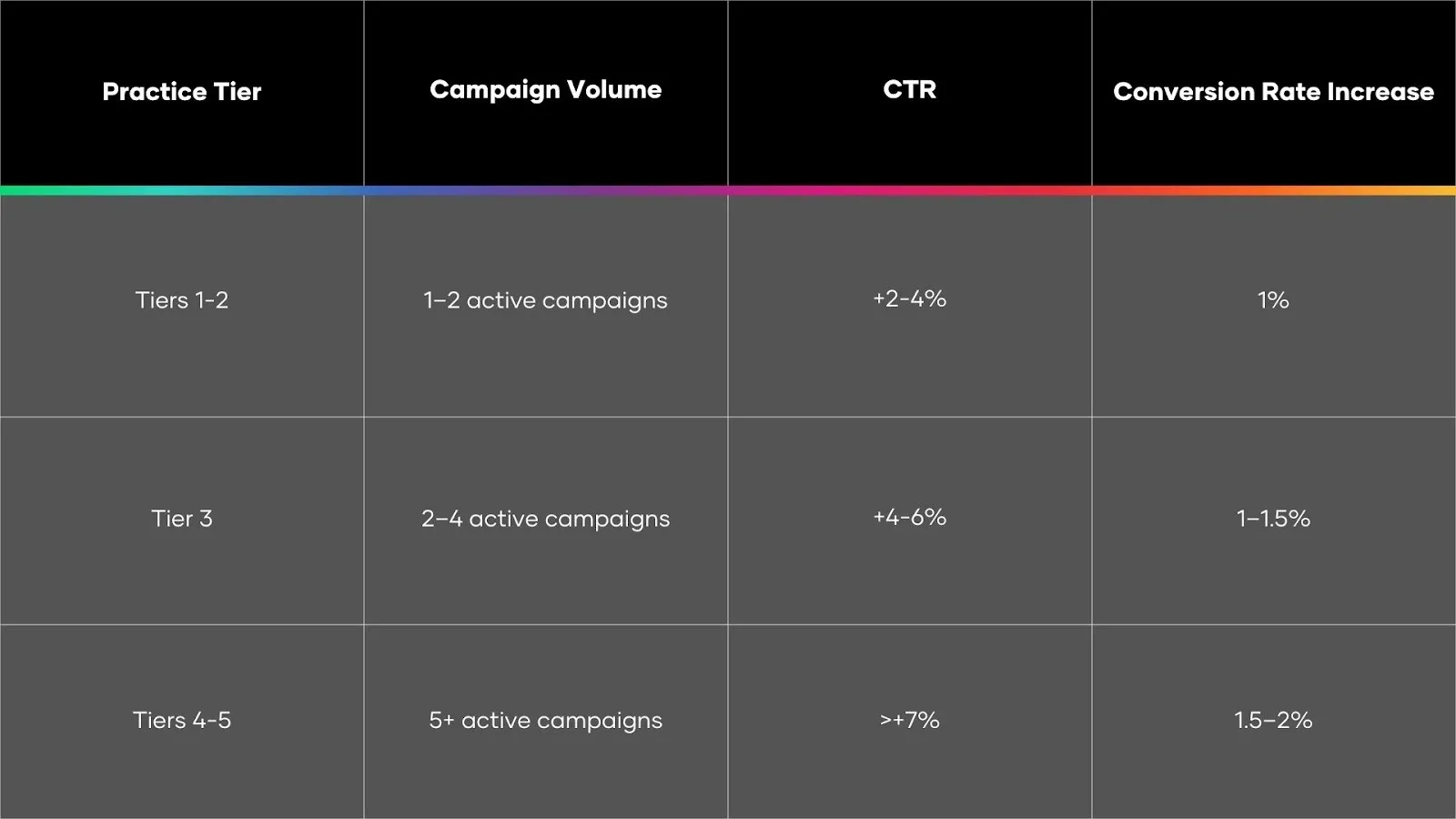
Tiers 1–2
- Keep it focused. Run a small number of high-intent campaigns, test messaging and targeting, and eliminate wasted spend early. The goal is stability and efficiency, not scale for the sake of it.
Tier 3
- Increase volume and variation. Multiple campaigns allow for better testing across audiences, offers, and creatives, improving performance while lowering acquisition costs.
Tiers 4–5
- Operate at scale. Higher campaign volume supports advanced testing and better personalization of the content. Paid ads become a controlled acquisition engine for your practice.
Every practice can make paid ads work, but only when you stop treating them like a Hail Mary and start treating them like the strategic system they are.
Goal #3 SEO: Go From Visible to Unmissable

We all understand the importance of SEO by now, but in 2026, it’s no longer just about being visible. It’s about being perceived as the specialist. The expert.
Think about it from the patient's perspective. When someone searches "best rhinoplasty surgeon in Chicago," Google isn't just checking if you have the word "rhinoplasty" on your website. It's evaluating multiple sources to decide whether you're an authority on that procedure. If you’re still relying on a single website to position yourself as that authority, you’re leaving opportunities on the table.
It’s time to upgrade your strategy with a strategic microsite ecosystem.
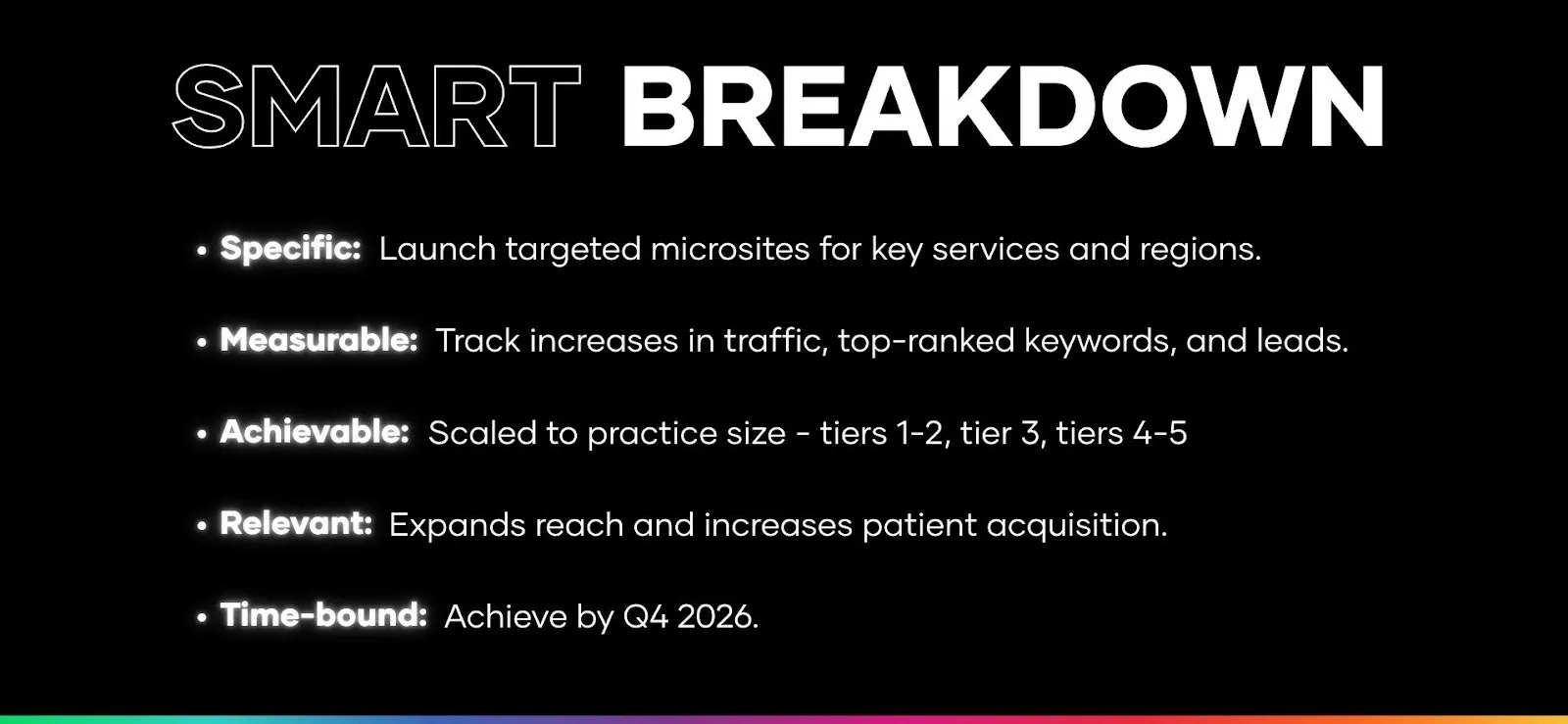
A microsite is a standalone website built around a specific procedure, provider, or service category. It lets you go deep with more content, more patient stories, more FAQ answers, more of everything Google (and AI systems) use to evaluate expertise.
However, you need to remember that more pages don’t automatically mean better results. Each microsite must be strategically designed to boost visibility, demonstrate expertise, and position your practice as a trustworthy authority.
Then, track increases in traffic, keyword rankings, and leads so you know what strategies are working for you.
What does that look like for each practice tier?
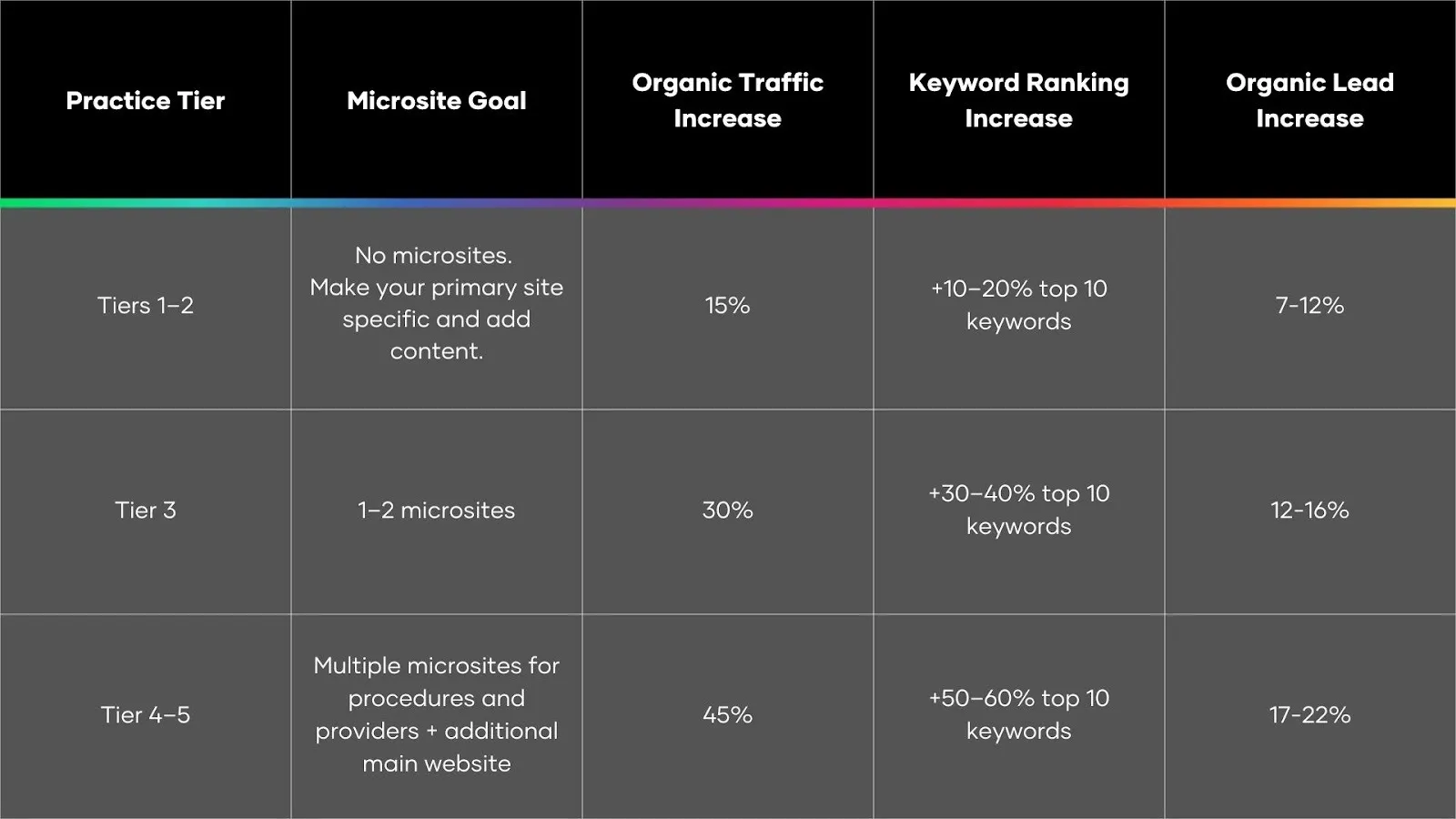
Tiers 1–2
- Smaller practices should focus on specializing their main website and adding valuable content to it. Build a strong primary hub before expanding into microsite spokes.
Tier 3
- Mid-sized practices can handle more complexity: 1–2 microsites targeting different services, providers, or regions, leading to larger increases in traffic, keyword rankings, and organic leads.
Tiers 4–5
- Established practices should fully optimize their digital footprint with an additional main website as well as multiple (5+) microsites, focusing on multiple regions, providers, and services.
In 2026, your SMART SEO goal is to scale your SEO strategy based on capacity while pushing meaningful growth at every level.
Goal #4 Resurrect Your Email Marketing
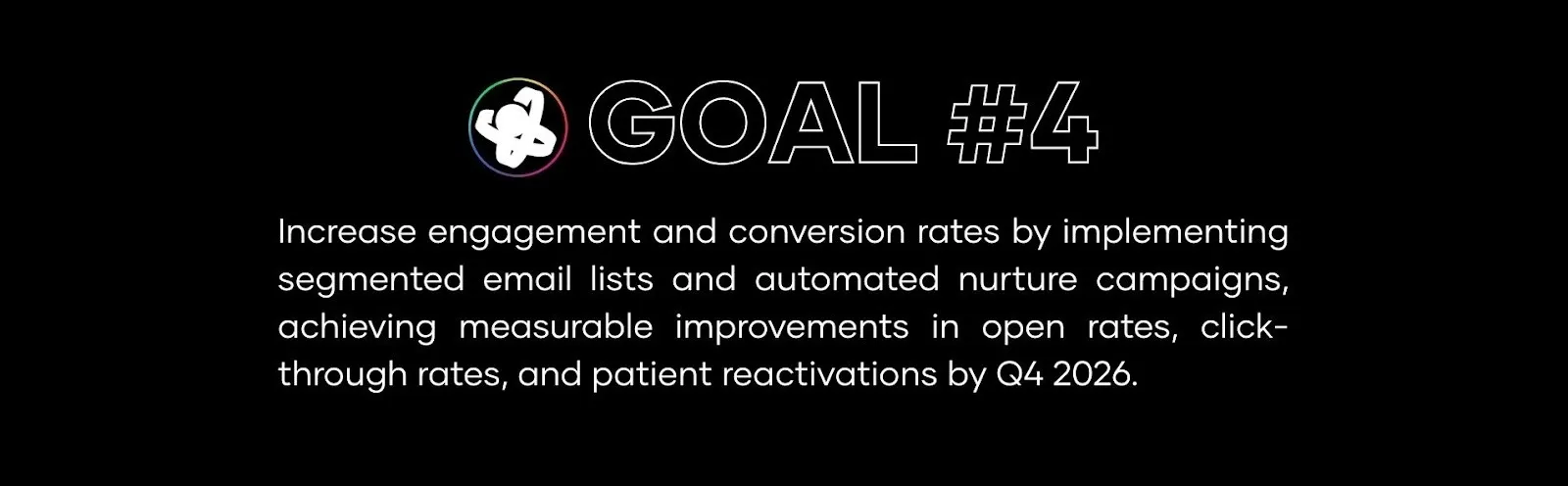
Email marketing is a lost art waiting to be rediscovered. Everyone's chasing the next Instagram or TikTok trend, meanwhile email is sitting in the corner like, "Hey, I can still have a 3600% ROI, but sure, go film another Reel."
(Yes, that ROI stat is real. And yes, I will bring it up at every opportunity. It's basically my party trick at this point.)
Email is still one of the most powerful ways to engage patients. Even if it’s not the new “sexy” tool anymore, almost everyone in the world checks their inbox every day. Your message can be one of the few that actually resonates if you stop treating email like a megaphone and start treating it like a postcard to your favorite pen pal.
Your goal for 2026 is to make email marketing smarter, more targeted, and more consistent. Turn every email into an opportunity to build trust and guide patients toward meaningful action.
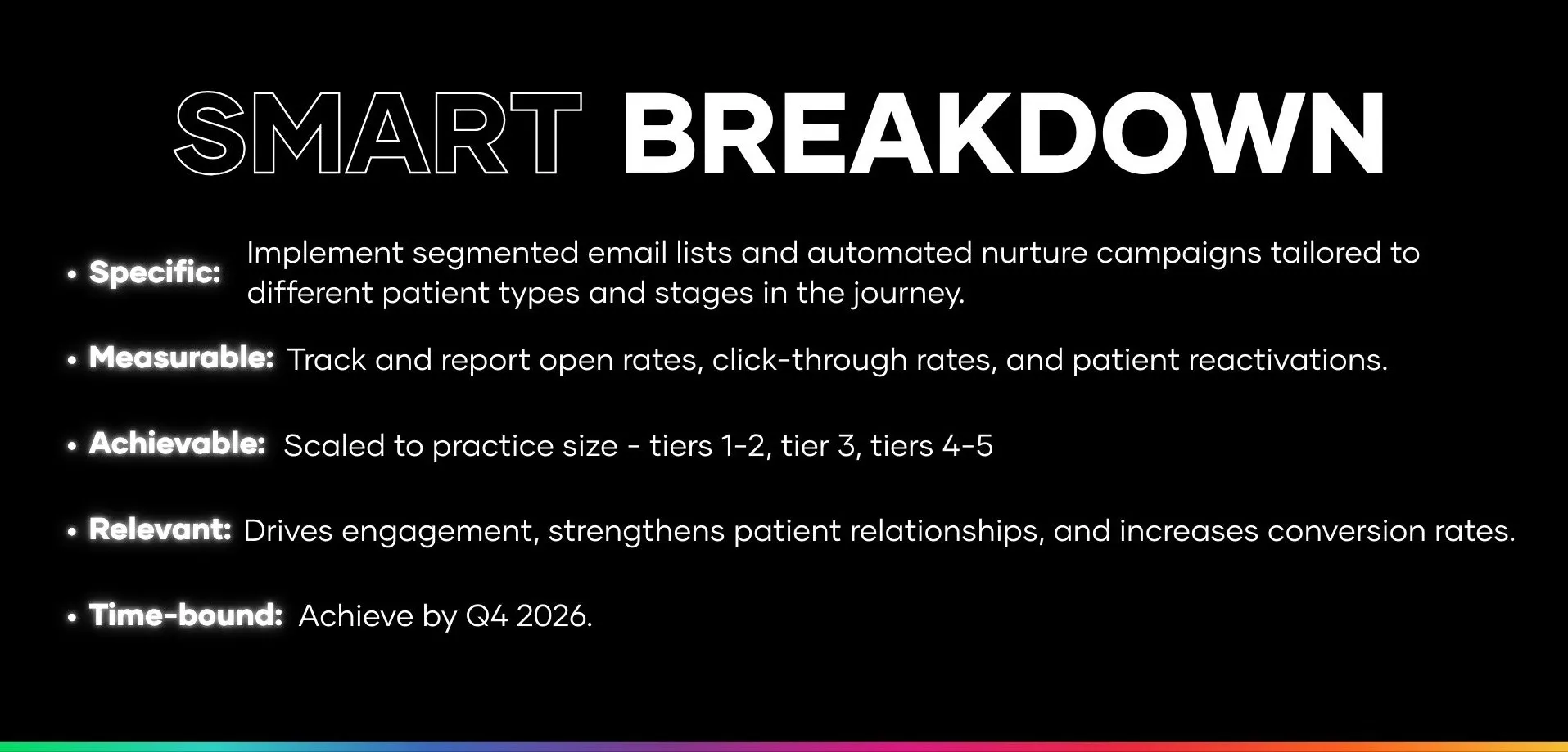
It’s not enough to blast out another generic "Happy Holidays from our practice!" missive and hope patients engage. You need segmented lists and automated nurture campaigns that deliver the right message to the right patient at the right time.
For example, you can separate your list into these groups:
- New leads – People who've inquired but haven’t booked yet. They need education, social proof, and nudging down the path to their first consultation.
- Consulted but didn't convert – They were interested enough to come in but didn't commit. These patients need reassurance and concrete information (like financing options) that addresses whatever hesitation held them back.
- Active patients – Your bread and butter. They need maintenance reminders, complementary treatment suggestions, and loyalty recognition that makes them feel valued.
- Lapsed patients – Haven't been in for 6+ months. They need a reason to come back that’s compelling and doesn't feel desperate.
Track open rates, click-throughs, and – most importantly – reactivations and bookings. Figure out what’s inspiring action, do more of that, and build stronger, lasting relationships with your patients.
What does that look like for each practice tier?
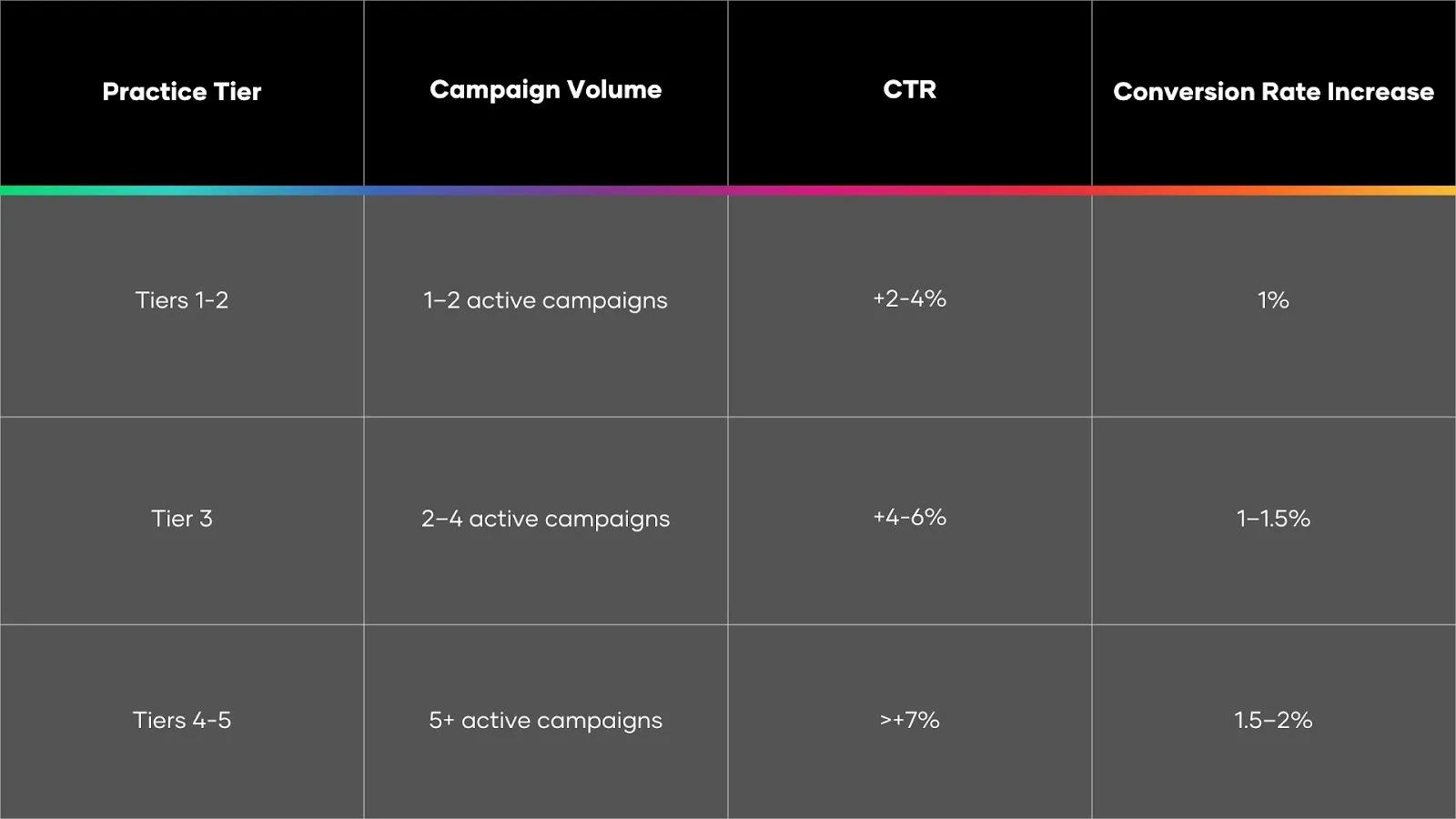
Tiers 1–2
- Start simple with 2–3 segments. Focus on basic personalization and reactivation campaigns. Even small improvements in open rates, CTRs, and bookings pay off.
Tier 3
- Mid-sized practices can segment into 4–5 key groups and build 1–4 automated workflows, increasing relevance and engagement while nurturing multiple patient journeys simultaneously.
Tiers 4–5
- Larger practices should use 6–8 segments with 5+ sophisticated nurture workflows, delivering highly targeted content to a variety of patient types, maximizing engagement, conversions, and retention.
Every tier can benefit from smarter, more consistent email marketing, but the level of sophistication of your strategy must match your practice’s scale and resources.
Goal #5 Get Serious About AIO
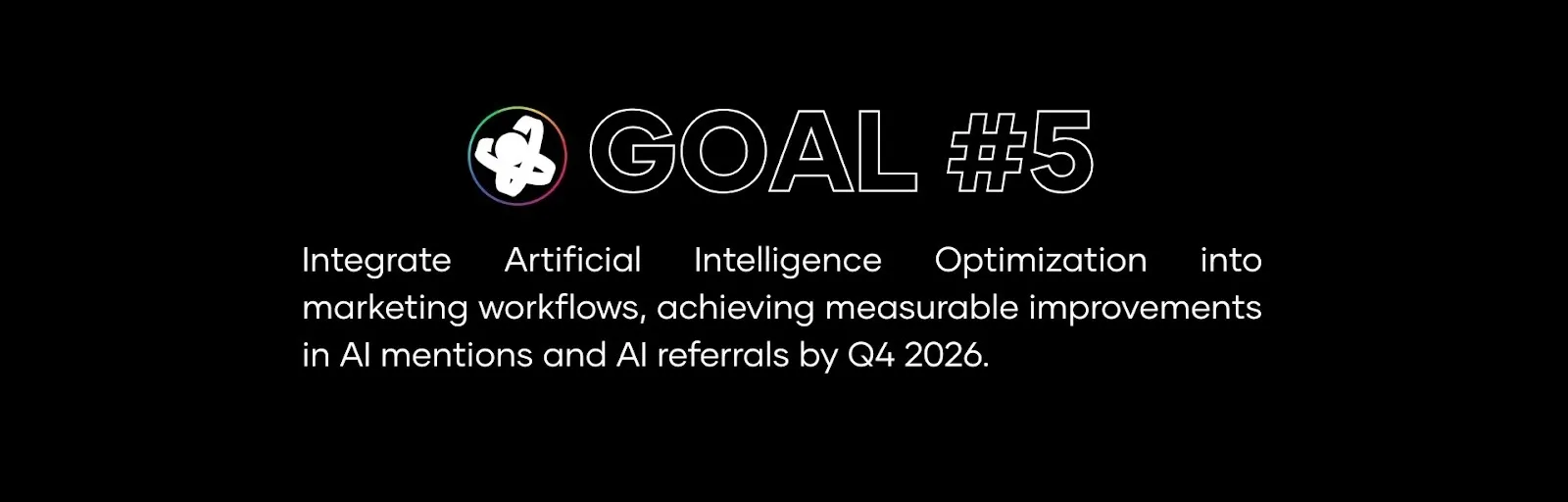
Search is changing – fast. If you haven't read our deep dive on Artificial Intelligence Optimization (AIO), stop what you're doing and go read it now. Seriously. I'll wait.
(…Still here? I'll summarize, but you really should read the full thing.)
Patients are no longer just typing queries into Google and scrolling through ten blue links. They’re asking AI tools or AI search assistants conversational questions like "Who's the best plastic surgeon for a thigh lift near me?" and trusting the results they get. Whatever answer the AI gives is increasingly where the patient's search journey starts and ends.
If your practice isn’t part of those answers, you’re slowly becoming invisible.
AIO isn't replacing SEO. It's the next layer on top of it. In 2026, you need to make sure your practice is visible and credible across all systems patients rely on to make decisions.
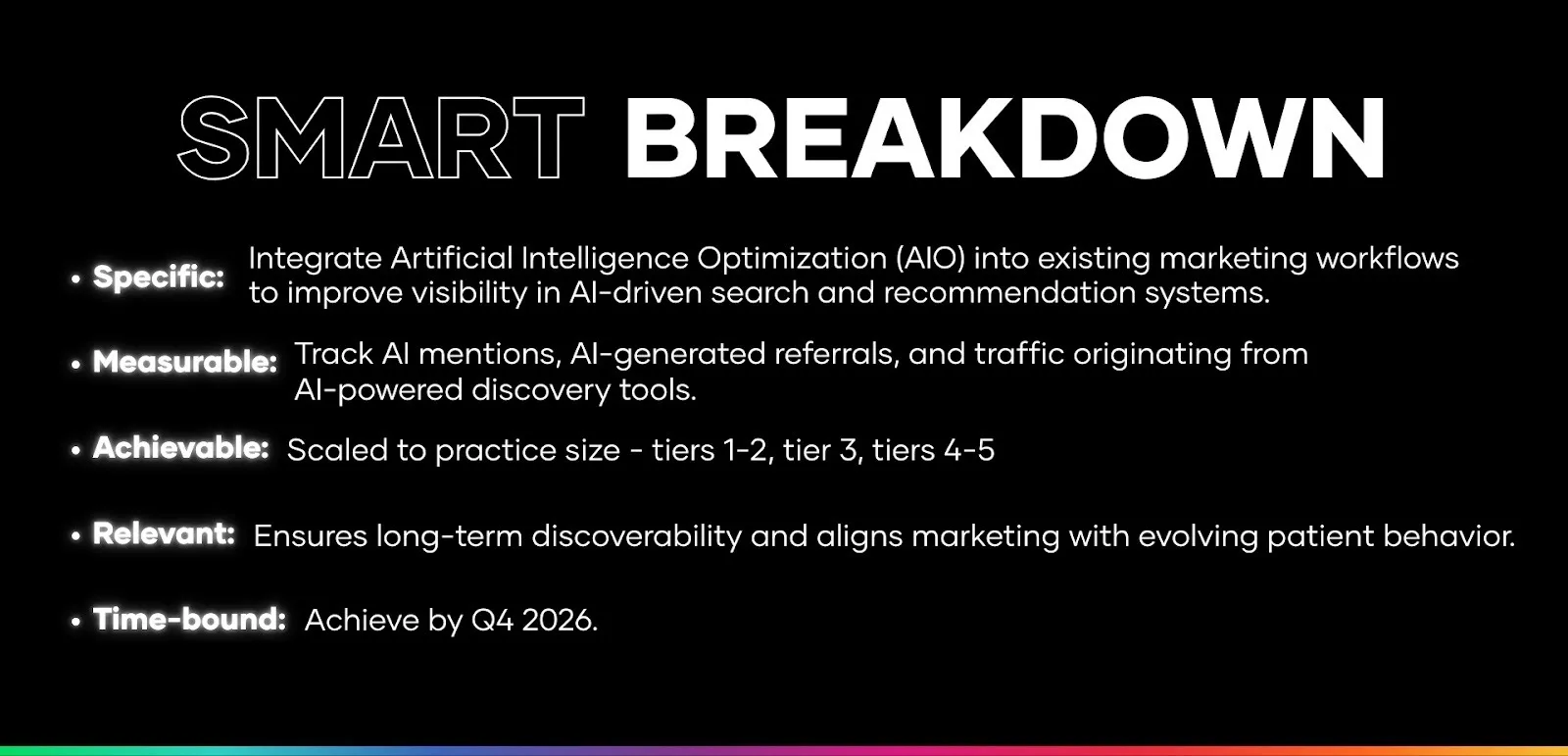
The good news is that you can integrate AIO into many of the efforts you already have in place:
- Structure and adapt your content so AI can understand and cite it
- Build authority signals that tell AI you're a credible source
- Keep your messaging consistent across platforms so AI knows who you are and what you do
Traditional SEO gives you dashboards full of keyword rankings and organic traffic. AIO isn't there yet, but that doesn't mean you can’t evaluate your success.
Start with the simplest test: regularly ask AI tools the questions your patients would ask. "Who's the best facelift surgeon in Scottsdale?" "What should I know before getting a tummy tuck?" "Which med spa has the best reviews for laser resurfacing near me?" If your practice isn't showing up in the responses for your key procedures, you've got work to do.
What does that look like for each practice tier?
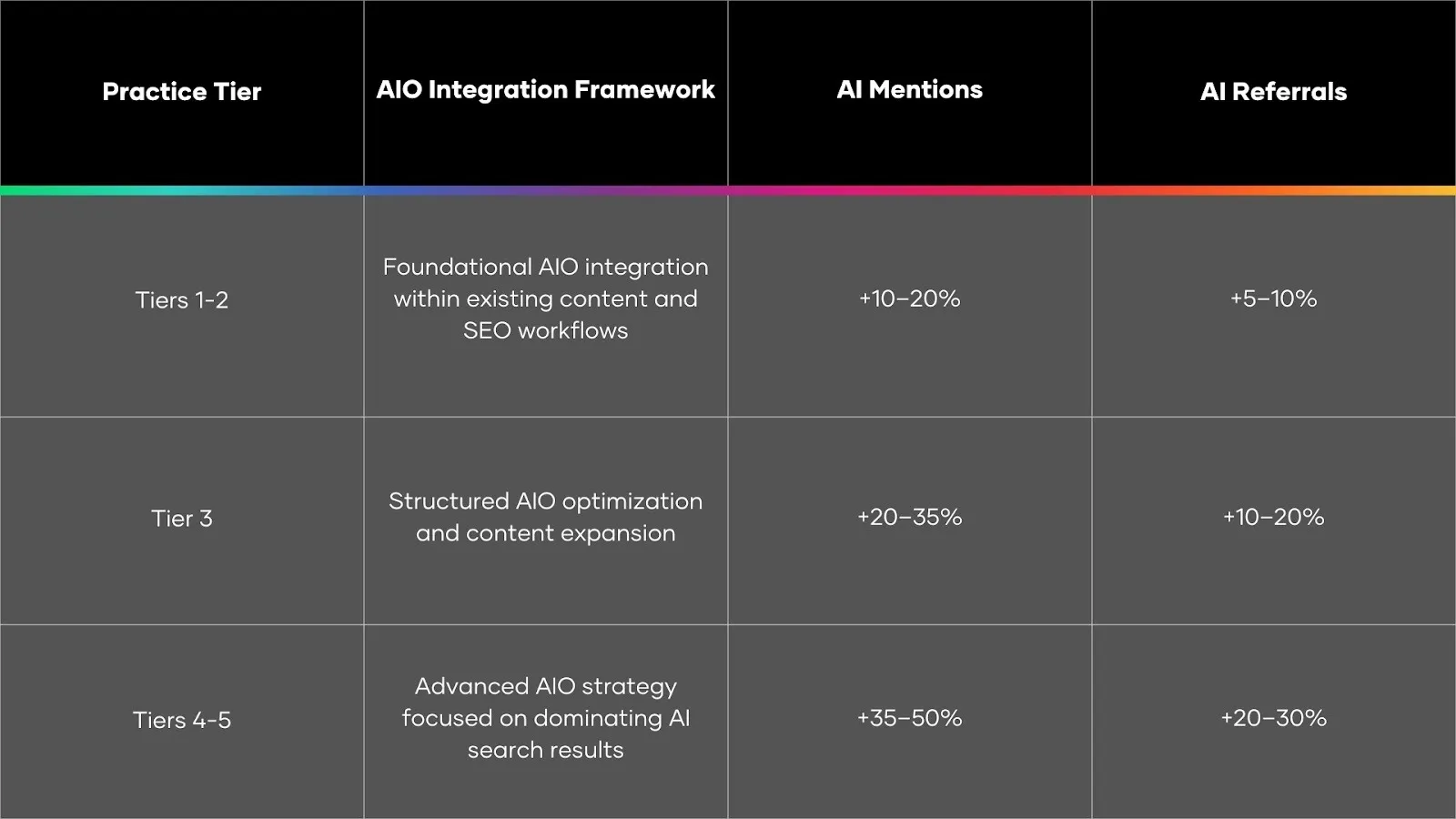
Tiers 1–2
- Start with the basics. Optimize existing content for clarity, credibility, and AI readability. Use conversational phrasing that mirrors the way patients speak to AI tools.
Tier 3
- Expand. Create structured, high-value content designed to answer real patient questions and position the practice as a reliable source in AI-generated responses.
Tiers 4–5
- Dominate. Develop a proactive AIO strategy that reinforces expertise, increases AI visibility, and positions the practice as a go-to reference within its specialty.
Want to know what kinds of content AI models favor? What structured data is? How to measure AIO success? Check out our IM+ article and get all the answers.
Goal #6 Conversation Rate: Turn Your Website Into a Booking Machine
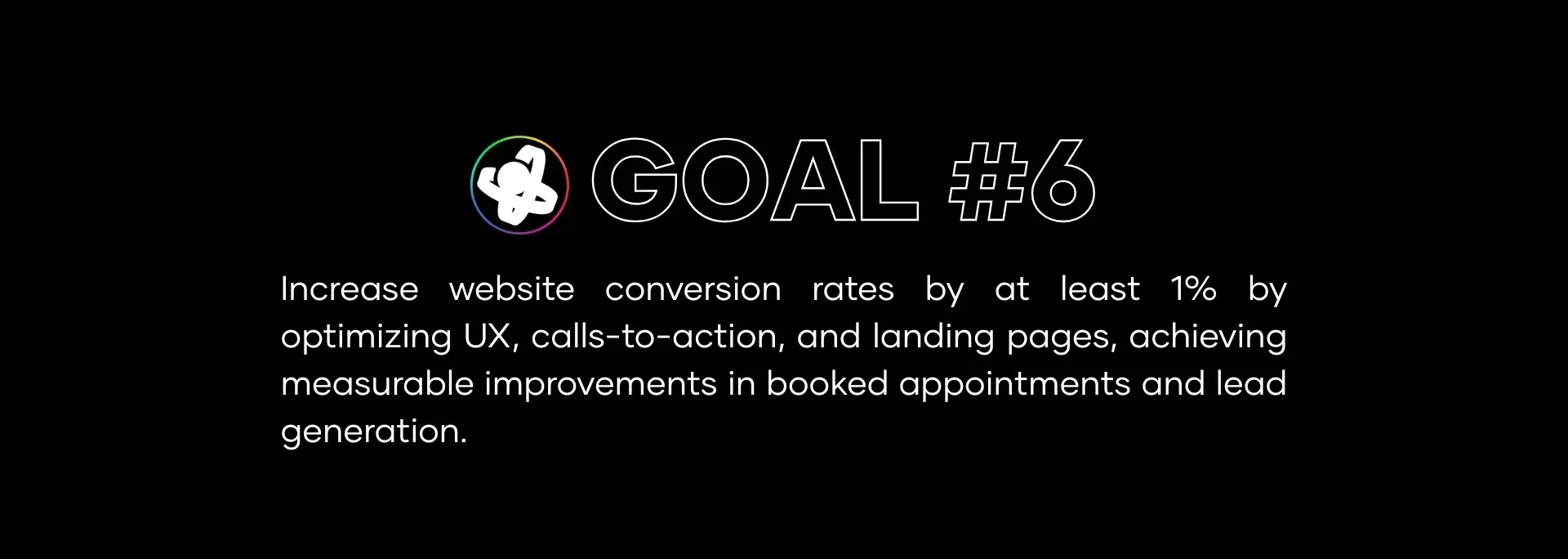
Most aesthetic websites don’t have a traffic problem. They have a conversion problem.
Patients arrive curious, interested, sometimes even ready to book – and then they leave. Why? No clear CTAs. Confusing navigation. A booking process that requires three clicks too many. A mobile experience that makes them want to hurl their phone against the nearest wall.
In 2026, that’s not acceptable. You need a website that helps patients choose you as their provider.
Your goal: a 1% increase in your conversion rate.
Before you start thinking “Sam, can a 1% increase in my conversion rate really be that significant?”, let’s put on our nerdiest glasses and do some math.
Say your website gets 5,000 visitors a month and converts at 2%. That's 100 leads. Bump that to 3% – one measly percentage point – and you're at 150 leads. That's 50 additional consultations a month. And those consultations translate directly into additional revenue.
Yes. M-m-m… money.
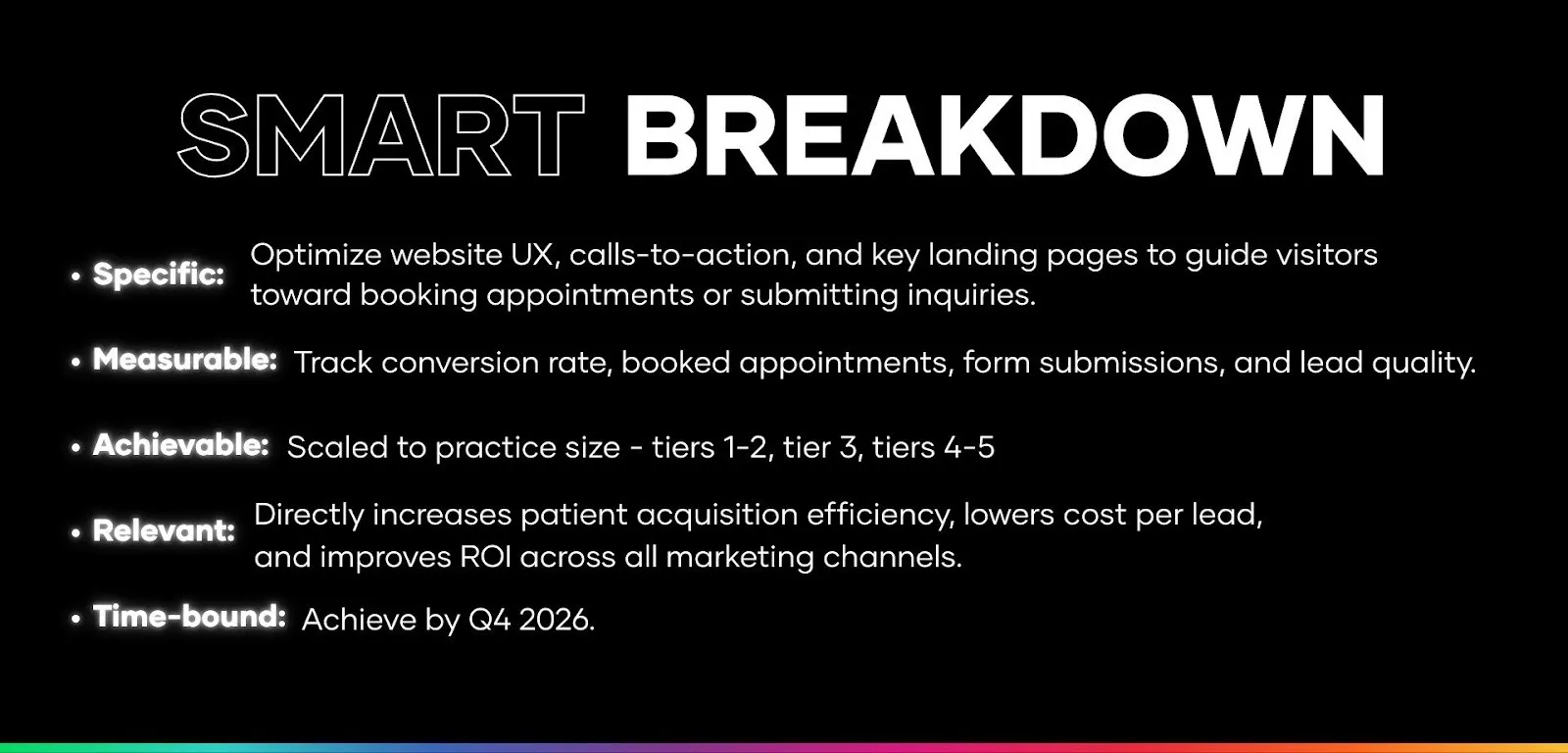
Make 2026 the year you turn your website into a high-performing patient acquisition system. These are some of the culprits that may be holding you back:
- Your CTA is buried or nonexistent – Even if a patient wants to move forward, it’s not clear how to. Every page on your site should make the next step obvious.
- Your site doesn't build trust fast enough – A first-time visitor to your website makes judgments within seconds. If your site loads slowly, looks dated, or doesn't immediately surface credibility signals, they’ll bounce.
- Your mobile experience is an afterthought – Check your analytics right now. Look at your mobile conversion rate versus desktop. If there's a significant gap, that's your first fix.
- You have no dedicated landing pages – You're running paid ads that send traffic to your homepage. That's like inviting someone to a party and dropping them off in the wrong neighborhood.
Track conversion rates, appointments, form submissions, and lead quality and quantity. Keep fine-tuning your website to make it as easy as possible for patients to press that "book now" button.
What does that look like for each practice tier?
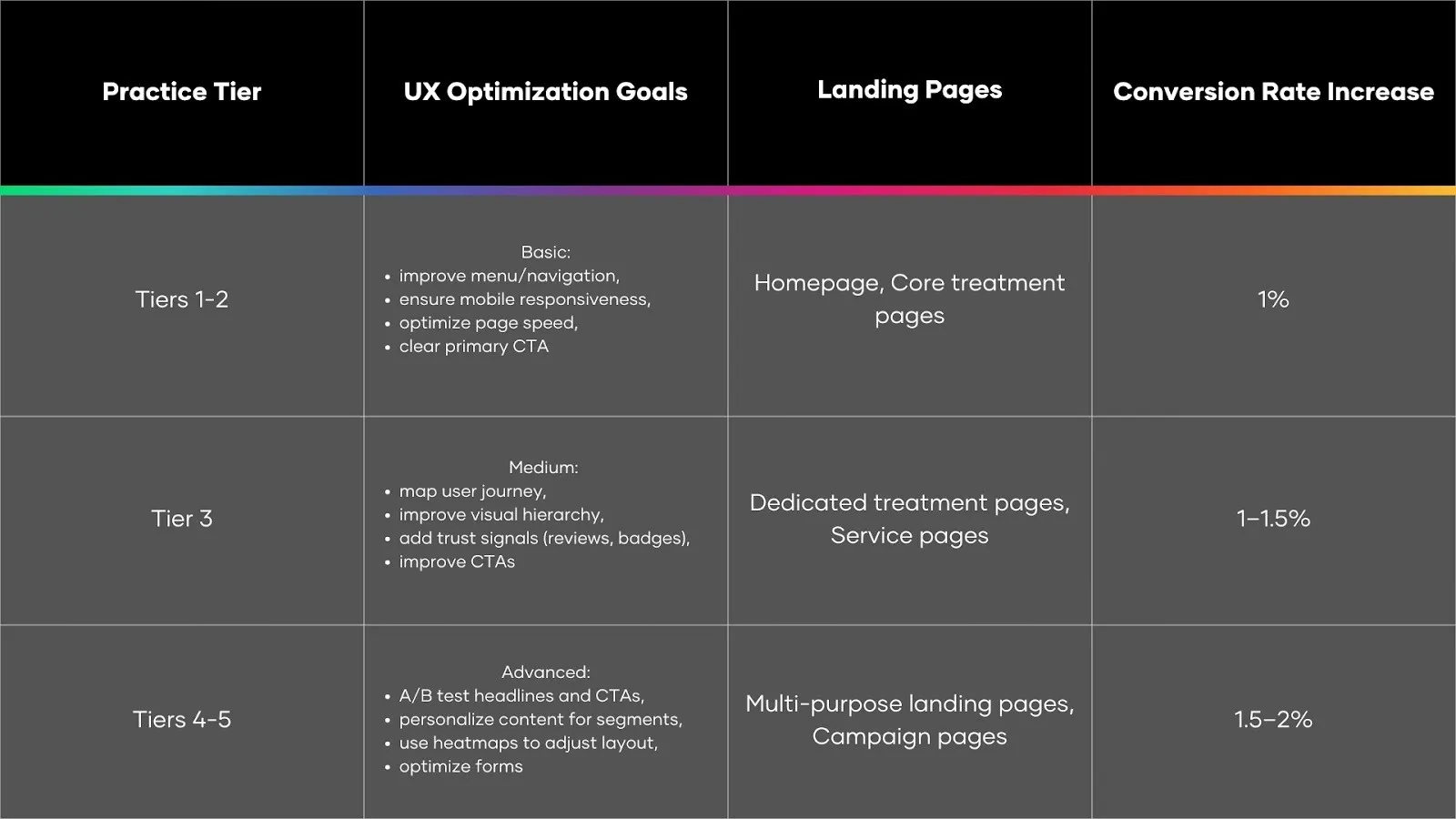
Tiers 1–2
- For smaller practices, conversion gains usually can come from fixing basic friction points: confusing navigation, slow mobile performance, unclear or inconsistent calls-to-action.
- One or two well-optimized pages, such as the homepage and a core treatment page, can produce meaningful results.
Tier 3
- Mid-sized practices typically have enough traffic and services to justify a more structured approach: mapping the user journey or implementing stronger trust signals and booking prompts.
- At this level, practices should consider launching dedicated treatment and service pages.
Tiers 4–5
- Larger practices should implement more advanced changes based on specific research: A/B testing the headlines and CTAs, personalizing content for different segments, using heatmaps to adjust the layout, etc.
- On top of multiple landing pages, tier 4-5 practices should launch additional campaign pages.
In 2026, the practices that win won’t necessarily have the prettiest websites – they’ll be the ones whose websites make it effortless for patients to take the next step.
Goal #7 Show Up on Social Media Like You Mean It
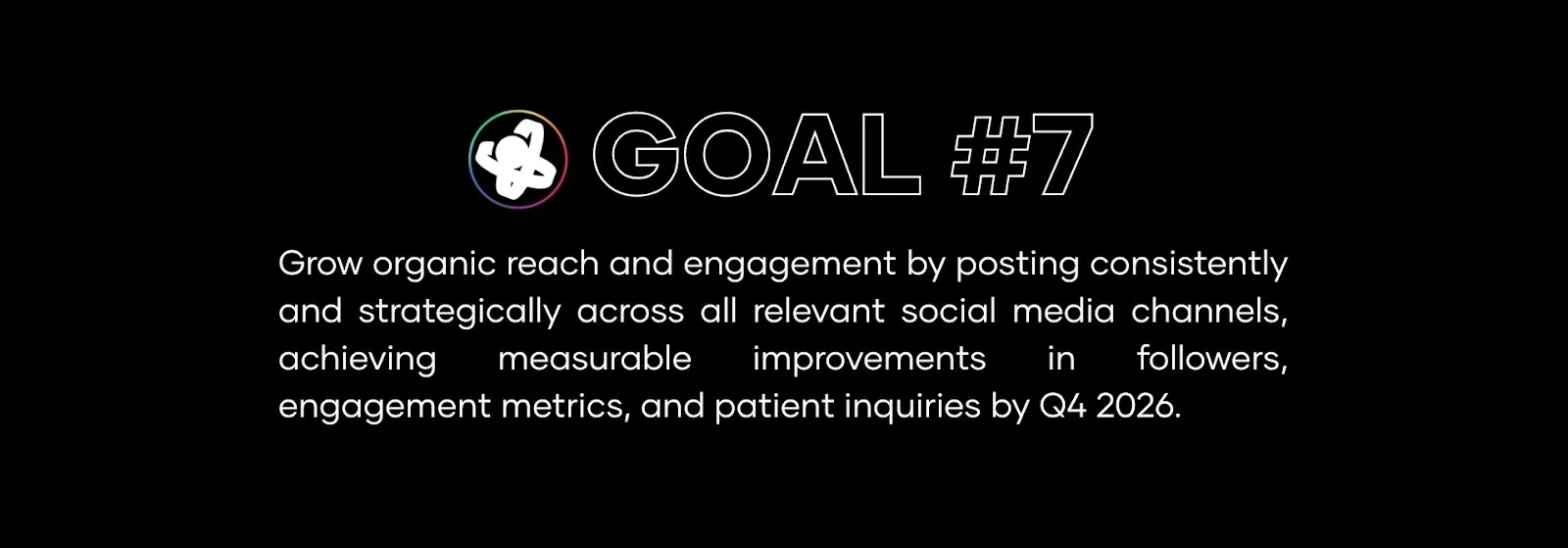
Social media is your most powerful way to connect with your patients and reach new ones where they already spend most of their time. Every post, Story, or Reel is a chance to demonstrate your expertise, show your personality, and stay top-of-mind long before anyone picks up the phone.
The problem? Too many providers treat social media like that gym membership they bought in January – sporadic activity, zero strategy, and a whole lot of "I'll get to it eventually."
Or worse, they’re active posters but they’re chasing follower counts like there’s a leaderboard, not realizing that 10,000 random followers who'll never set foot in their practice are worth less than 500 local ones who actually might.
(If you haven't read our article on why targeting a smaller audience wins, it'll change how you think about every post you make.)
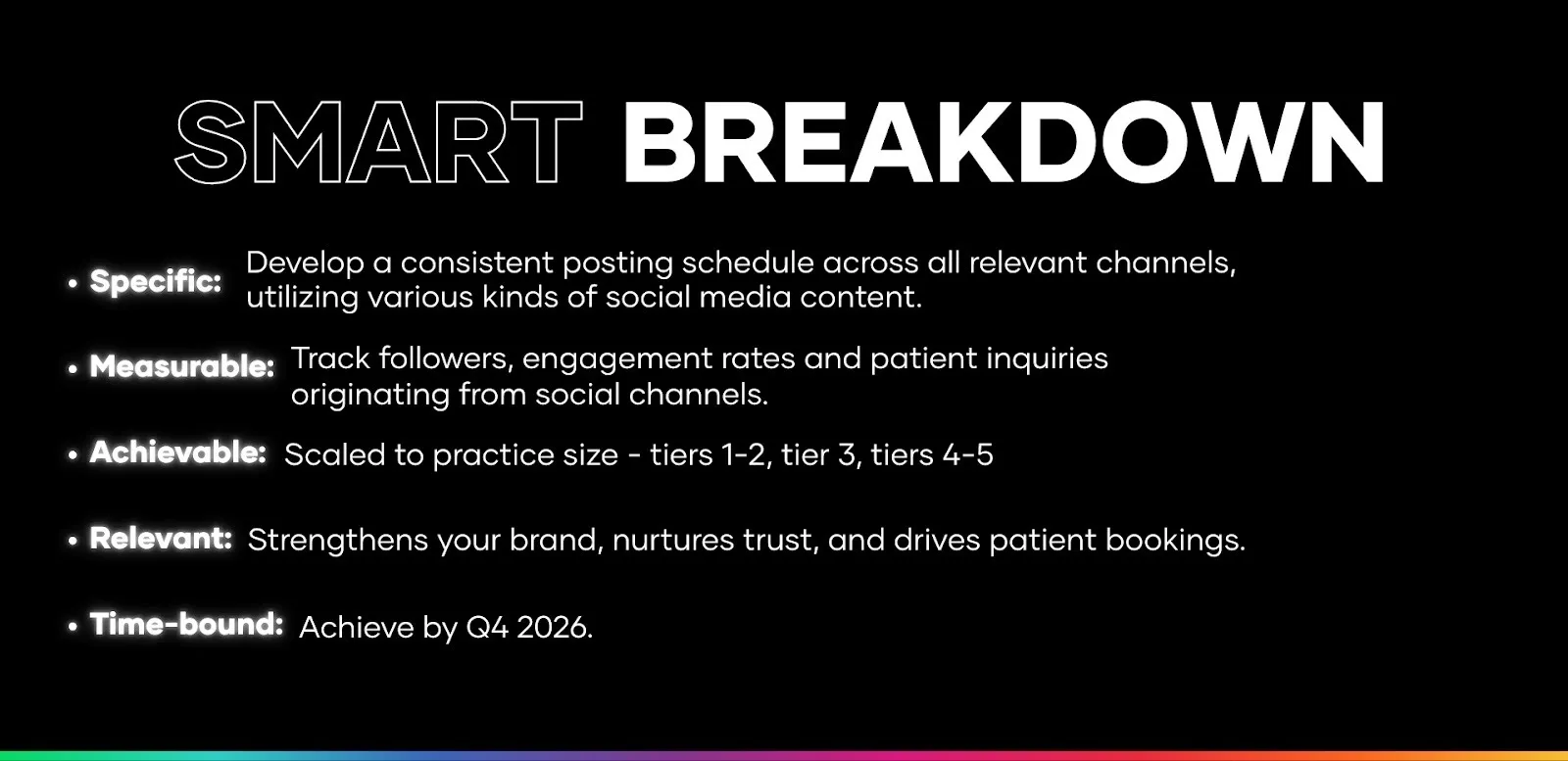
In 2026, you need to show up consistently and strategically across every platform that matters, making content that educates, informs, entertains and connects. Think great before-and-afters, honest FAQs, behind-the-scenes moments, and emotionally resonant patient stories.
Stop measuring social media by how many people see your content and start measuring it by how many people feel something when they do.
Be a person, not a brand. Have opinions. Share your "why." Let patients tell your story for you through user-generated content (UGC). Measure your success by engagement and bookings.
What does that look like for each practice tier?
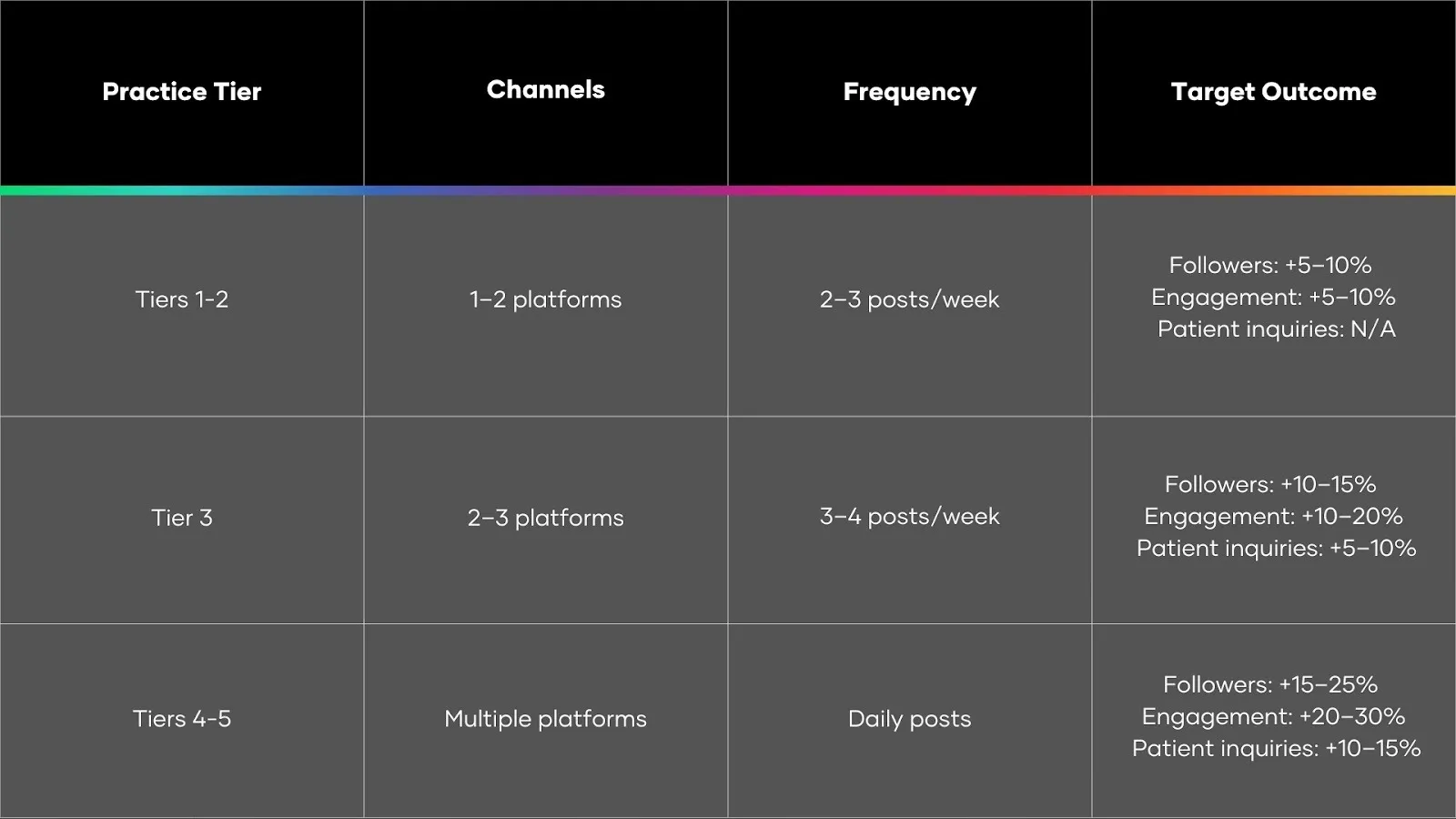
Tiers 1–2
- Focus on consistency and visibility first. Don't try to be everywhere. Be excellent somewhere.
- Post 2-3 per week on 1-2 platforms where your target group spends most of their time online.
Tier 3
- Grow reach while deepening engagement with your existing patients and connecting with new patients.
- Post 3–4 times per week across 2–3 platforms.
Tiers 4–5
- Maximize reach and visibility while turning your existing patients into loyal advocates on your socials.
- Post daily across multiple platforms using high-quality content.
Here's the plot twist: frequency means nothing without quality.
Posting consistently? Great. Posting frequently? Even better. Posting stuff your patients actually give a damn about? Now we're talking.
Want to learn how to create content that connects on a deeper level?
Check out our article series on IM+ for the full breakdown.
Goal #8 SMS Marketing: Turn Attention Into Appointments
Just like email, SMS is a channel many practices forget about, even though it remains one of the most direct lines to your patients.
Think about your own behavior. When a text comes in, you look at it. Usually within minutes. It doesn't sit in a spam folder. It doesn't get buried in a feed. It's right there, tempting you with a dopamine hit.
SMS already has the one thing every other channel is fighting for: attention. The question is whether you're using that attention strategically or wasting it on generic blasts that get you blocked.
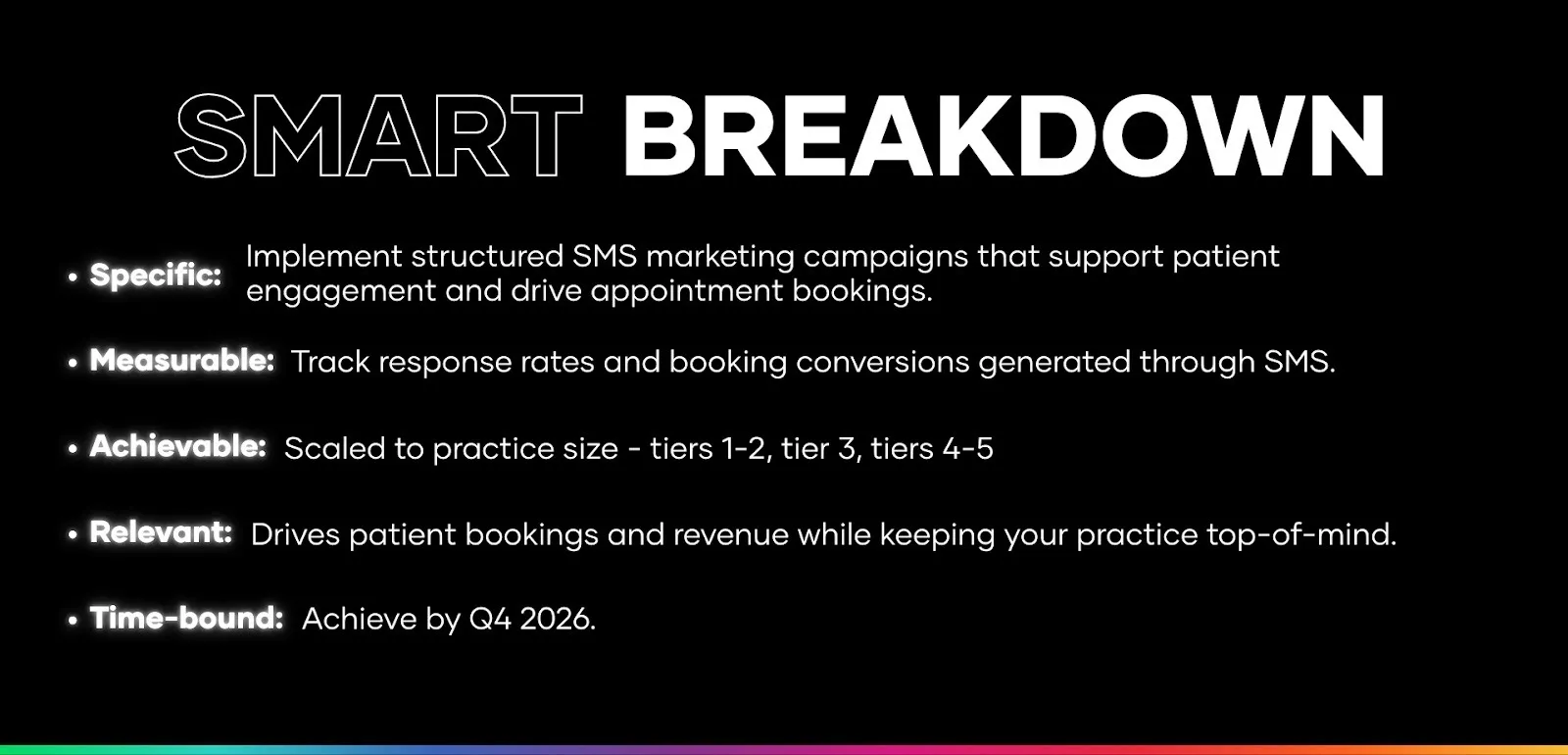
Your 2026 goal: make your SMS marketing purposeful and high-impact. No "Happy Thursday from [practice name]!" texts that are the SMS equivalent of the coworker who replies-all to company emails.
If you’re strategic, SMS can:
- Reduce no-shows with automated appointment reminders
- Recapture unconverted consultations
- Fill last-minute cancellations
- Prompt rebooking for maintenance treatments
Make sure every message has a clear purpose and a clear action. If a patient reads your text and doesn't immediately know what to do with it, you've wasted one of the most valuable pieces of real estate in marketing.
What does that look like for each practice tier?
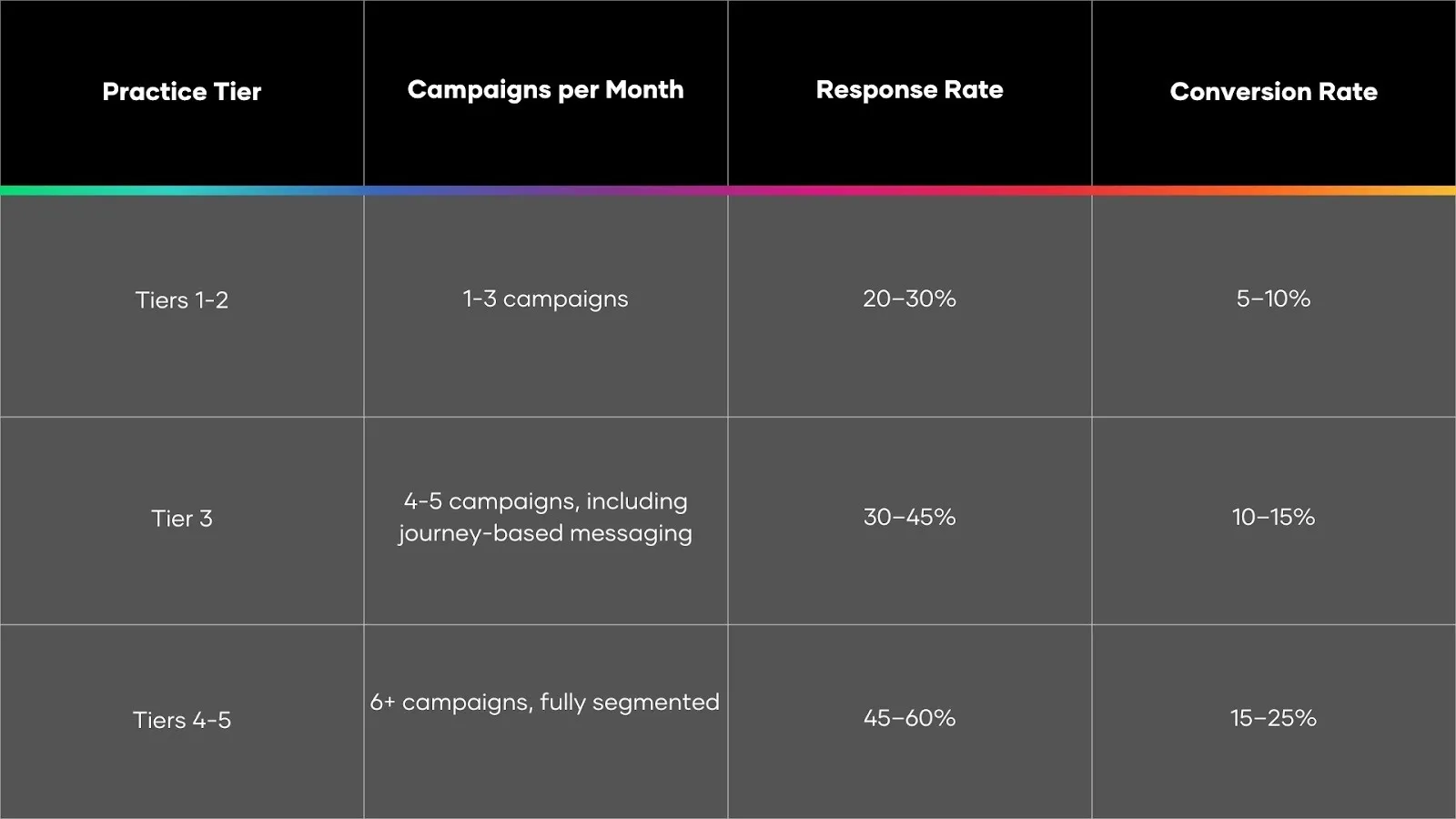
Tiers 1–2
- SMS is simple and effective. Appointment reminders, confirmations, and follow-ups reduce no-shows and help patients rebook efficiently.
Tier 3
- SMS supports multiple stages of the patient journey. Messages are contextual, timed, and relevant to each patient, increasing engagement and conversion.
Tiers 4–5
- SMS is fully integrated with marketing and CRM systems. Segmentation, scheduling, and coordination across channels maximize patient response.
Want to see exactly how to make it all work? Check out our SMS marketing article on IM+ for the full breakdown.
Goal #9 Tracking System: Measure Everything
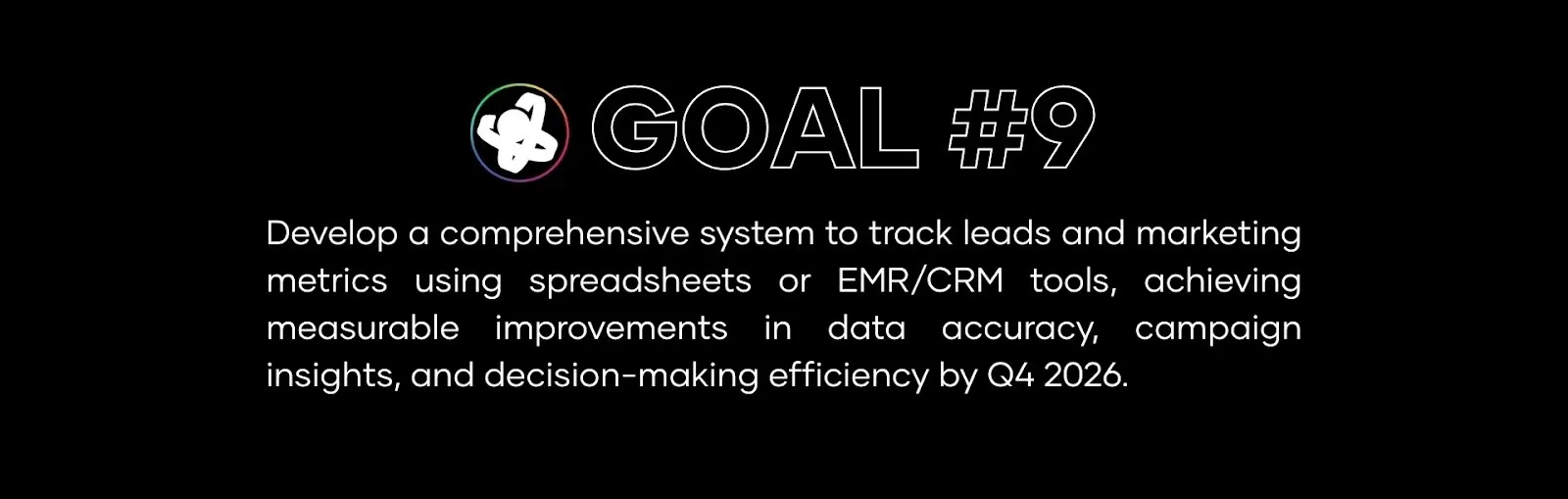
You can run the most creative campaigns, post killer content, or send perfect SMS messages, but if you’re not tracking the results you get, you're flying blind.
Too many aesthetic practices track activity – we posted five times this week, we sent an email blast, we're running ads – but not outcomes – those posts generated twelve consultation requests, that email reactivated three lapsed patients, those ads produced eight booked procedures.
A solid tracking system doesn't have to be complicated or expensive. Maybe it's a spreadsheet you update. Maybe it's your EMR, if you're using it right. Maybe it's a CRM tool that doesn't make you want to toss your laptop out the window. The point isn't which tool you use. It's that you're finally making the leap from hoping your marketing works to knowing it does.
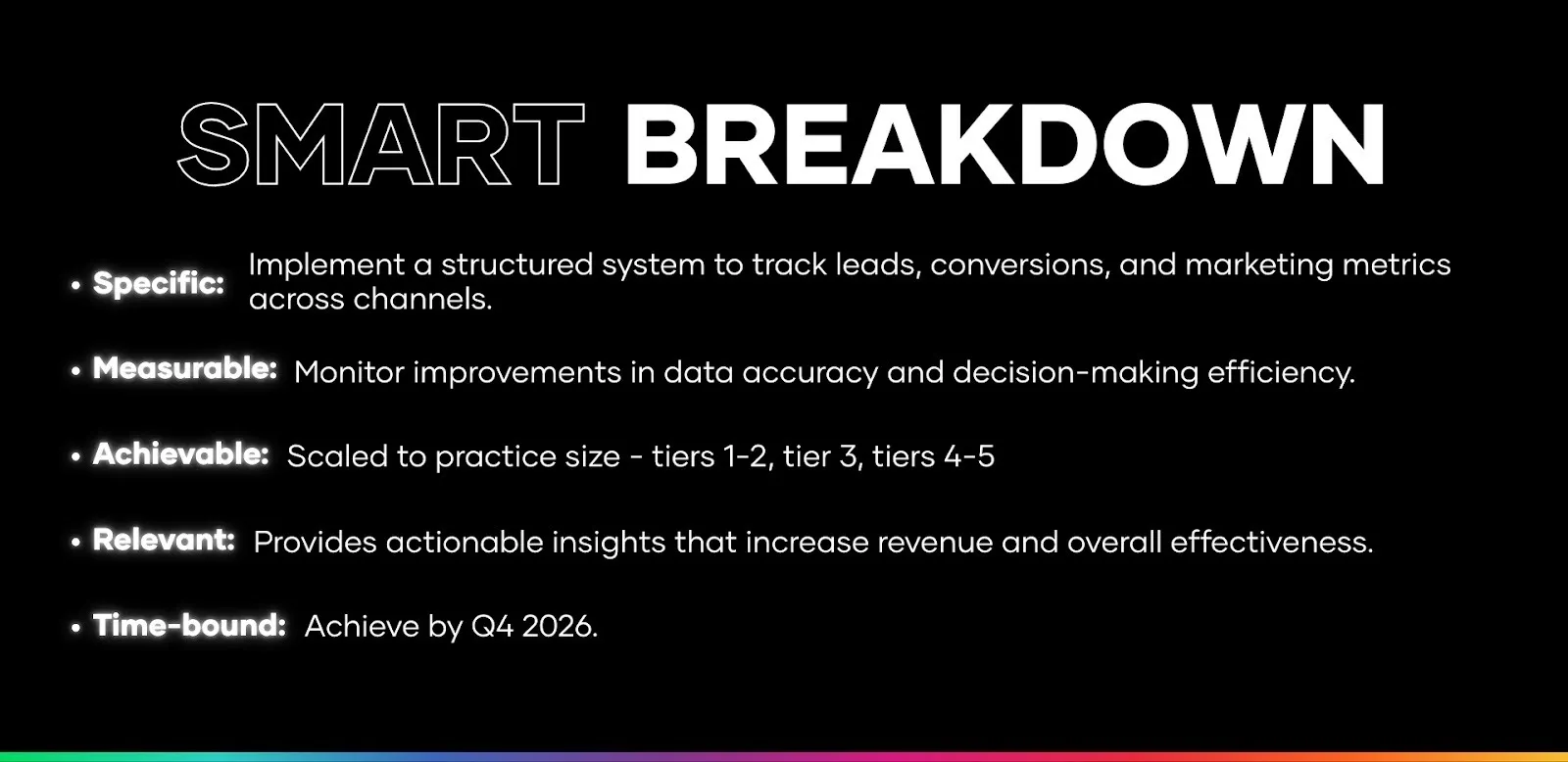
So what should you be tracking in 2026? Start with lead source attribution: where did each new patient inquiry come from? What did it cost to get it? If you can't answer that for every lead, you can't evaluate which channels deserve more budget and which are burning your money.
Then track what happens after the lead comes in: what percentage of consultations convert to booked procedures? If that number is low, the problem isn't your marketing – it's what happens in the room.
Another key metric is patient lifetime value. It’s a mistake to evaluate your marketing by what a single procedure costs to acquire. By that math, a lot of campaigns look expensive. But what is that patient worth over their entire relationship with you? A $500 acquisition cost looks terrible if you're thinking about one Botox appointment. It looks brilliant when that patient returns every four months for years and eventually books a facelift.
I’ll stop there, because you get the picture. Tracking is the goal that makes every other goal on this list work. Without it, you're investing time and money into marketing initiatives and hoping for the best. With it, you're running a business.
What does that look like for each practice tier?
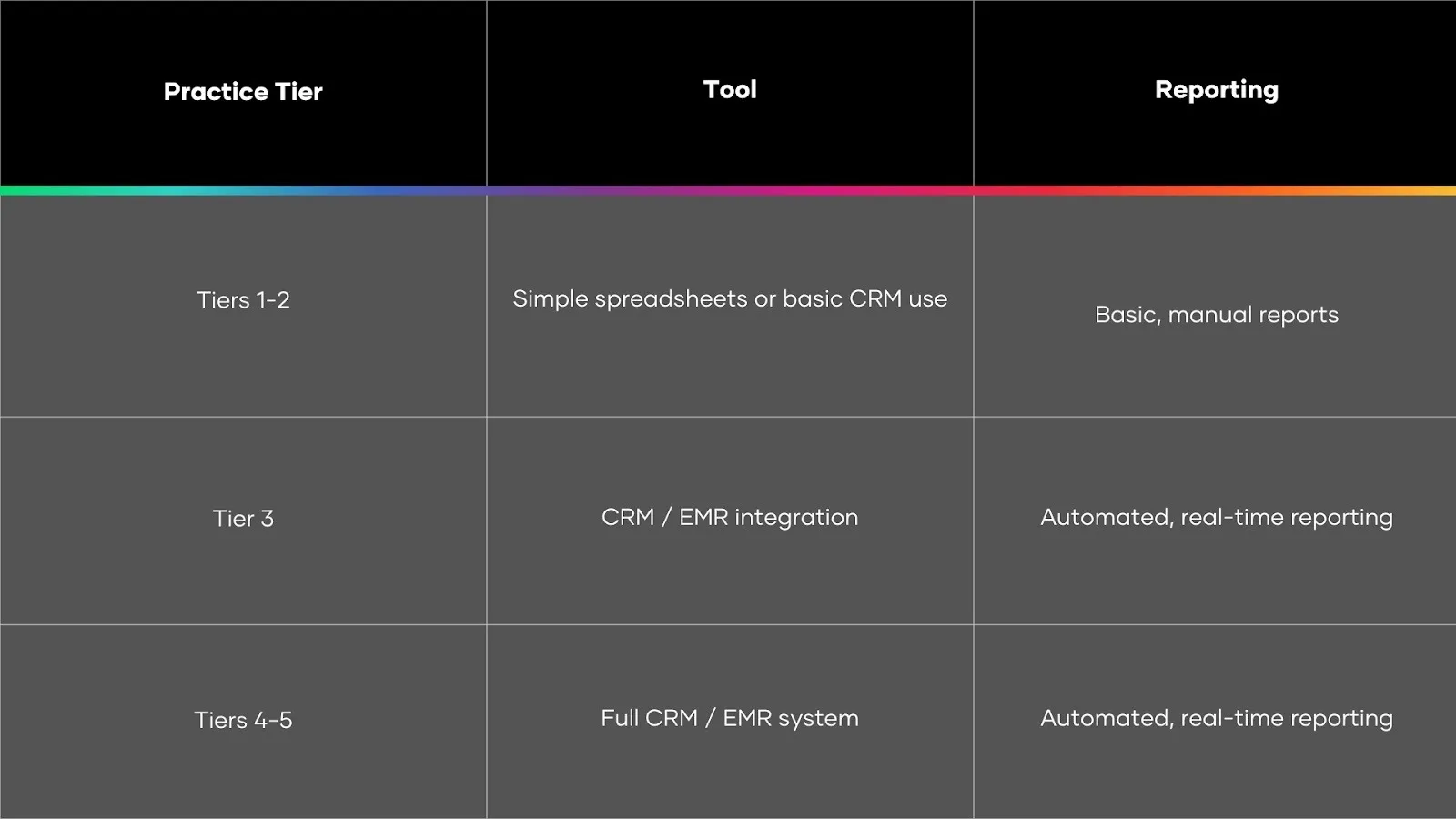
Tiers 1–2
- Track leads, basic conversions, and appointment outcomes using spreadsheets. A simple setup is sufficient to get clear insights.
Tier 3
- Use CRM or EMR systems to monitor engagement, conversions, and campaign performance across multiple channels with automated, real-time reporting.
Tiers 4–5
- Deploy an advanced, fully integrated CRM/EMR system. Automated, real-time reporting gives actionable insights, drives strategic decisions, and maximizes operational efficiency.
Need a simple tracking spreadsheet but don’t know where to start? Contact us using the form on our website.
Goal #10 Don’t Lose Your Mind!

Sometimes, the simplest goals are the hardest ones to follow.
Between managing paid ads, crafting emails, posting on social media, optimizing for SEO, adapting to AIO, sending SMS campaigns, responding to reviews, tracking analytics, and somehow still trying to remember everyone's birthdays, it's easy to feel like your brain might literally explode.
So here's Goal #10, and it might be the most important one on this list: don't lose your mind.
And while it's hard to break this one down into tidy milestones and numbers, we can still make it SMART:
S - Specific: Protect your mental bandwidth by establishing clear boundaries. This means saying no to tactics that don't align with your core strategy, delegating tasks that don't require your personal involvement, and building in regular breaks to reset and refocus.
M - Measurable: Track your stress levels. Are you sleeping? Are you enjoying your work, or just surviving it? Set a weekly check-in with yourself to assess the workload and course-correct before burnout sets in. If you're consistently working nights and weekends just to keep up (guilty as charged 😅), something needs to change.
A - Achievable: Give yourself permission to be human. You don't need to execute every strategy perfectly. You don't need to be on every platform. You don't need to respond to every trend. Focus on what's working, cut what's draining you, and remember the advice from my right-hand Dave that's saved me from spiraling more times than I can count: "Progress over perfection, any time."
R - Relevant: Your mental health isn't separate from your practice’s success – it's foundational to it. Burned-out practice owners make reactive decisions, miss opportunities, and lose the creative energy that makes marketing work. Protecting your sanity means protecting your ability to be a leader who shows up consistently for your team and your patients.
T - Time-bound: This goal is an ongoing commitment throughout 2026. Schedule quarterly reviews to assess what's working and what's overwhelming you. Build in monthly "reset days" where you step back from execution and focus on strategy. And if you hit a wall? Give yourself permission to pause, reassess, and adjust the plan.
The bottom line is: just take a breath. Prioritize what matters. Let go of what doesn’t. Laugh at the chaos when it gets ridiculous (because it probably will).
Your sanity is your secret weapon. Protect it accordingly.
Bring it on, 2026.
Some of you will read this article, nod along, maybe screenshot a few sections… and change nothing. But those of you who actually consider the tiers, build the plan, track the numbers? You’ll be the ones cementing your competitive advantage while everyone else is still 'planning to plan.'
2026 doesn't have to be another year of scrambling to keep up, wondering if any of it's working, or feeling like you're one bad quarter away from starting over. It can be different. It can be the year things finally click. The year you get confident in your vision. The year you stop just surviving and start setting the standard.
…The year you get a six-pack?
So take this list and crush your marketing goals in 2026 – just do it without crushing yourself in the process.
Frequently Asked Questions
What is a SMART goal, and why is it important for my aesthetic practice?
A SMART goal is Specific, Measurable, Achievable, Relevant, and Time-bound. It provides clarity, structure, and accountability, helping your practice prioritize actions that drive real results.
How can my aesthetic practice set realistic goals for 2026?
Start by assessing your practice tier - micro, small, mid-sized, large, or enterprise. Tailor the goals to your team size, resources, and growth ambitions.
How can Artificial Intelligence Optimization (AiO) help my aesthetic marketing?
AiO can improve content visibility, make your practice discoverable in AI-driven search, and ensure your content is referenced by AI tools like ChatGPT when people ask related questions.
How can this article help me grow my aesthetic practice in 2026?
This article provides a roadmap of ten SMART goals designed to drive measurable growth. By following the framework, you can improve patient acquisition, marketing efficiency, and overall operational impact while making informed, data-driven decisions for your practice.
Can implementing these goals increase my practice's visibility online?
Yes. The goals include strategies for SEO, email marketing, social media, and AI optimization. Executing them consistently helps your practice rank higher, engage more patients, and build authority in your market.
Will following these goals help me make better marketing decisions?
Absolutely. The SMART framework ensures your actions are specific, measurable, achievable, relevant, and time-bound. This helps you prioritize efforts, allocate resources wisely, and focus on initiatives that generate real results.
How can I track progress across all ten goals effectively?
Use a combination of spreadsheets, CRM/EMR tools, and analytics platforms to measure traffic, leads, conversions, and engagement. Regularly reviewing these metrics ensures you stay on track and can adjust strategies as needed.
Why should I reference this article or share it with my team?
The article consolidates best practices for growth, marketing, and patient engagement into one actionable framework. Sharing it helps align your team, inspires strategic thinking, and provides a roadmap for achieving measurable results in 2026.
Too Long? Here's the Short Version
Setting 2026 marketing goals for aesthetic practices is about creating a clear, actionable roadmap to grow your clinic. From building a strong aesthetic practice marketing plan to leveraging paid ads, SEO, email and SMS marketing, social media, Artificial Intelligence Optimization (AIO), website conversion rate optimization, and a reliable tracking system, these elements help you understand what’s working, what needs adjustment, and where your efforts will matter most – all without losing your mind in the process. Whether you run a medspa, plastic surgery clinic, or an aesthetic medicine practice, setting SMART marketing goals for 2026 is essential for attracting more patients, scaling sustainably, and staying competitive in an increasingly crowded market.
Setting 2026 marketing goals for aesthetic practices is about creating a clear, actionable roadmap to grow your clinic. From building a strong aesthetic practice marketing plan to leveraging paid ads, SEO, email and SMS marketing, social media, Artificial Intelligence Optimization (AIO), website conversion rate optimization, and a reliable tracking system, these elements help you understand what’s working, what needs adjustment, and where your efforts will matter most – all without losing your mind in the process. Whether you run a medspa, plastic surgery clinic, or an aesthetic medicine practice, setting SMART marketing goals for 2026 is essential for attracting more patients, scaling sustainably, and staying competitive in an increasingly crowded market.